Fuat Tosyalı, chairman of Tosyalı Holding and the Turkish Steel Producers' Association (TÇÜD), has called for closer coordination between carbon emissions measurement, decarbonization financing and international trade policies to support the global steel industry's green transformation.
Speaking at the 31st United Nations Climate Change Conference (COP31) panel titled “Green Steel Transformation and New Business Models from an Industrial Resilience Perspective” in Antalya, Turkey, Tosyalı emphasized that climate policies should prioritize measurable emissions reductions while ensuring that investments in low-carbon steel production remain commercially viable. The panel, moderated by TÇÜD secretary general M. Veysel Yayan, also featured representatives from the World Steel Association (worldsteel), the European Steel Association (EUROFER) and the Turkish Ministry of Trade.
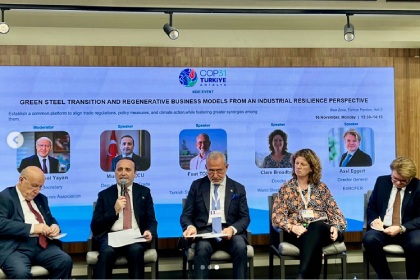
Product-level emissions verification and carbon pricing alignment emphasized
Independent verification of actual emissions at product level and recognition of carbon costs already paid by steel producers in their home countries are essential to avoiding double carbon pricing, according to Tosyalı.
Carbon revenues should also be directed toward investments in clean energy, energy efficiency, direct reduced iron (DRI) technology and hydrogen, he argued. The effectiveness of climate policies should be assessed based on actual emissions reductions rather than regulatory requirements alone.
Turkey's EAF production share and emissions performance
Highlighting differences in steel production methods, Tosyalı stated that electric arc furnaces (EAFs) accounted for 72.2 percent of Turkey's crude steel production in 2025, compared to 45.8 percent in the EU. Citing a 2022 European Commission Joint Research Centre study, he noted that emissions from EU steel production were 31 percent higher than those in Turkey, while China's emissions were almost twice as high. Tosyalı also criticized trade restrictions that could limit market access for low-carbon steel, arguing that climate and trade policies should encourage the consumption of products with verified lower emissions rather than impose additional barriers.
Raw material supply security is another key concern as global demand for cleaner steel production increases, according to Tosyalı. Turkey imported approximately 18.7 million mt of iron and steel scrap in 2025, underlining the country's exposure to international scrap supply conditions. Increasing demand for high-quality scrap and potential restrictions on scrap exports could create additional supply risks for scrap-dependent steel producers, he warned. To address these challenges, Tosyalı called for improvements in domestic scrap collection, sorting, traceability and quality, alongside greater access to alternative metallic raw materials, including DRI, hot briquetted iron (HBI) and cold DRI.
DRI investments in Algeria and Libya highlighted
Steel decarbonization investments should take into account regional differences in energy availability, raw material access, logistics infrastructure and production costs, Tosyalı stressed. Referring to Tosyalı Holding's investments, he noted that the company's two DRI plants in Algeria have achieved record production levels, while their hot charging technology provides an energy-use advantage of up to 20 percent compared to conventional cold charging. The company's second Algerian DRI plant is designed to accommodate hydrogen use, while its cold DRI investment in Libya forms part of Tosyalı Holding's broader raw material supply strategy.
Lastly, Tosyalı called for stronger industrial cooperation between Turkey and the EU, arguing that combining Turkey's low-carbon steel production capabilities with Europe's industrial and technological expertise could improve competitiveness on both sides. In this context, he urged the EU to provide preferential treatment to Turkey as a green steel-producing partner and increase the relevant steel import quotas. The green transition should be supported through reliable, competitive and low-carbon international supply chains rather than policies that restrict industrial cooperation, he concluded.