Fuat Tosyalı, chairman of Turkish steel producer Tosyalı Holding, has highlighted Turkey's potential to become a hub for green industrial transformation, emphasizing that the country's future industrial strategy should focus on advanced technologies, value-added production and low-carbon manufacturing.
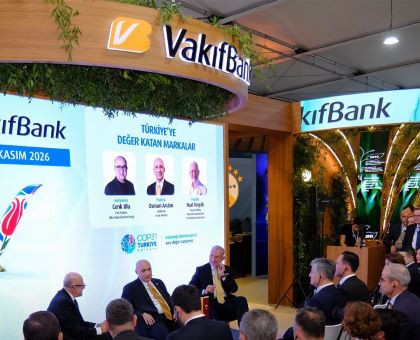
Speaking at the “Brands Adding Value to Turkey” panel, organized by Turkish lender VakıfBank during COP31, Tosyalı discussed changing global industrial competition, the company's sustainability-focused investments and opportunities for stronger industrial cooperation with Europe. The panel, moderated by Cenk Ulu, senior partner at PwC Turkey, also featured VakıfBank CEO Osman Arslan, who emphasized the importance of long-term financing and international partnerships in supporting industrial decarbonization.
According to Tosyalı, global industrial competitiveness is increasingly determined by energy and raw material security, technological capabilities, supply chain resilience and low-carbon production, rather than production costs alone. He stated that Turkey's industrial ties with the European Union, combined with its connections to Africa, the Middle East and Asia, could enable the country to become a center linking industrial investments and production chains across different regions.
Tosyalı Holding invests over $6 billion with sustainability at the center of its strategy
Tosyalı emphasized that sustainability has become a central consideration in the company's investment strategy. “We have made sustainability the starting point of all our investments rather than something added to production later,” he stated, adding that Tosyalı Holding has invested more than $6 billion over the past three to four years, with most of these investments following this approach.
He explained that the company's investments aim to establish a production structure characterized by greater energy and raw material security, improved resource efficiency, lower carbon intensity and stronger competitiveness in international markets.
Hydrogen-ready DRI investments in Algeria and Libya support low-carbon steel production
Regarding the company's international investments, Tosyalı stated that its operations in Algeria include two energy-efficient direct reduced iron (DRI) plants. According to Tosyalı, the second plant is among the world's first facilities to enter commercial production using technology capable of operating on natural gas while also being suitable for hydrogen use.
The company is also developing hydrogen-ready DRI investments in Libya, where it plans to establish a total annual production capacity of 8.1 million mt. These investments form part of Tosyalı Holding's strategy to expand its production capabilities while reducing the carbon intensity of steelmaking operations.
1.4 GW of installed solar power capacity targeted in Turkey
In Turkey, Tosyalı Holding is investing in renewable energy and more efficient production technologies. The company's planned 1.2 GW of additional solar power capacity is expected to increase its total installed solar capacity, including existing facilities, to 1.4 GW.
According to Tosyalı, these investments would enable the company to meet approximately half of its electricity requirements through solar power. He emphasized that renewable energy investments, alongside improvements in production efficiency, are intended to strengthen the company's energy security, resource efficiency and international competitiveness.
Calls for stronger EU-Turkey industrial cooperation and Customs Union modernization
Tosyalı also stressed the importance of strengthening Turkey's industrial relations with the European Union in response to changing global economic and environmental conditions. He noted that Turkey has long been a reliable manufacturing and supply partner for European industry, with shared interests in green transformation, technological development, supply security and industrial competitiveness.
According to Tosyalı, modernizing the EU-Turkey Customs Union is particularly important, while Turkey should play a greater role in Europe's future industrial and technology investments. He also described COP31 as an opportunity for Turkey to demonstrate its ability to offer international partners reliable, competitive and low-carbon industrial cooperation.
VakıfBank emphasizes long-term financing for Turkey's industrial decarbonization
Meanwhile, VakıfBank CEO Osman Arslan stated that climate action and economic development should be addressed together, particularly in developing economies. He higlighted that Turkey's 2053 net-zero emissions target should be pursued alongside its industrial development priorities, with investment decisions playing a central role in determining the country's future competitiveness.
According to Arslan, industrial transformation requires long-term financing arrangements that match the investment periods associated with modernizing production lines and industrial facilities. He identified technical assistance, credit guarantee mechanisms and long-term financing as three essential components of supporting industrial transformation. Arslan concluded that combining long-term industrial investment with appropriate financing instruments and international cooperation would be essential for Turkey to achieve its climate and development objectives.