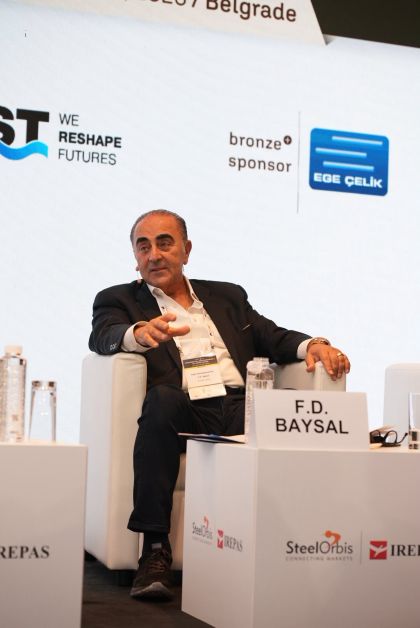
Speaking during the panel session on the last day of the SteelOrbis 2026 Autumn Conference & 95th IREPAS Meeting, held in Belgrade on September 27-29, F.D. Baysal, chairman and CEO of SEBA Group of Companies and chairman of the traders committee, shared the committee's assessment of current market conditions, highlighting weakening demand, regulatory pressures and rising geopolitical risks.
Mr. Baysal stated that steel trade is becoming more regional as tariffs, freight risks and additional import requirements complicate transactions. Presenting the findings of the IREPAS traders committee, Baysal said China had reduced steel production but continued to export large volumes. He stated that export licensing and VAT-related changes had altered the composition of its exports, with a greater share of long products. Continued weakness in China's real estate sector has left surplus production seeking overseas markets, he added.
Freight risks complicate steel trade in Middle East
Baysal described freight conditions as volatile, stating that shipping from Asia to Europe has remained relatively soft, while finding vessels for shipments to and from the Middle East has become difficult. War-risk premiums and higher bunker costs have added to the challenges faced by traders.
Regarding trade in the GCC region, Baysal said decisions can no longer be based solely on the price of steel and its shipping cost. Traders must also consider insurance, changing transit times and uncertainty over whether cargoes will arrive as planned. He stated that he expects logistics to remain a significant issue. Baysal said geopolitical freight premiums are not necessarily permanent. What has changed more durably, in his view, is the need to account for geopolitical risks in every transaction. Shipping routes, additional premiums and the working capital tied up in delayed cargoes have become part of traders' calculations.
High interest rates weigh on US steel demand
Baysal pointed out that higher interest rates are weighing on US commercial and residential construction and on demand for steel products used in those sectors. However, infrastructure, data centers, energy projects and manufacturing investment continue to consume steel. He noted that large infrastructure and data center projects are supplied mainly by domestic mills.
Against this background, Baysal said traders favor disciplined purchasing and low inventories. Back-to-back transactions are more attractive than speculative stockholding when financing is expensive and tariffs, quotas, freight and regional market conditions can change.
Capacity-demand gap and trade measures seen as interconnected risks
Although steel remains a cyclical industry, Baysal said its underlying trade structure has changed. Capacity growth, trade barriers and geopolitical risks have fragmented the market, requiring traders to identify opportunities in individual regions rather than rely on price differences alone.
Looking ahead to 2027, he described the gap between steel capacity and demand, and the trade measures that may result from it, as interconnected risks.