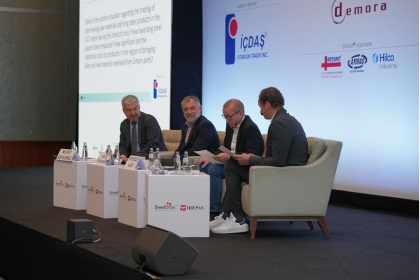
On the last day of the SteelOrbis 2026 Spring Conference & 94th IREPAS Meeting held in Amsterdam on April 26-28, Alex Gordienko, export director of Spain’s CELSA Group and chairman of the producers committee, stated, in sharing the producers committee’s findings, that the global steel industry is facing increasing pressure from rising costs, weak economic growth and regulatory complexity. He noted that uncertainty remains high, particularly due to ongoing geopolitical tensions.
Mr. Gordienko indicated that raw material prices have risen significantly, while the ability to pass these costs on to customers remains limited. As a result, margins across the industry are under sustained pressure, with finished steel prices failing to fully reflect higher input costs.
Weak growth constrains demand
Mr. Gordienko noted that economic growth remains subdued across many regions, limiting the potential for a meaningful recovery in steel demand. He warned that current conditions reflect a fragile balance, with demand holding but lacking strong momentum. He described energy markets as highly volatile, largely due to tensions in the Middle East, adding that there is no clear timeline for a resolution and that a prolonged conflict could significantly worsen market conditions.
Trade restrictions and CBAM reshape markets
The producers committee chairman went on to state that trade policy remains a key theme, with the EU’s Carbon Border Adjustment Mechanism (CBAM) at the center of discussions.
CBAM is seen as a mechanism that will gradually level carbon costs globally, encouraging countries such as Turkey, China and India to develop their own carbon pricing systems.
He said that, while CBAM is not expected to trigger immediate price changes, producers anticipate a medium-term disruption. By 2027, mills with verified emissions data are expected to gain a competitive advantage, as buyers increasingly prioritize suppliers able to provide reliable carbon data. Currently, only a limited number of suppliers, particularly in Japan and South Korea, are fully prepared for these requirements.
Meanwhile, the other restrictive factor, he pointed out, is that a new quota system stricter than the EU’s framework is expected to be introduced in the UK.
Logistics disruptions intensify
Mr. Gordienko commented that logistical challenges are adding further pressure, particularly in the Middle East, where port congestion is disrupting cargo flows. Limited truck availability and rising freight costs, driven by higher bunker fuel prices and fuel shortages, are increasing delivery costs for producers.
The CELSA Group official stated that production disruptions in Iran have significantly affected global semis supply. Publicly available information indicates that facilities representing around 10 million mt of capacity have been heavily damaged, with recovery timelines ranging from six to 12 months. Iran exported approximately 3 million mt of semis in 2025, with around 75 percent directed to Asia. The disruption has contributed to increased Chinese semi-finished exports, particularly in March, as China moved to fill the supply gap.
In the meantime, diesel shortages in Europe and transportation constraints are further amplifying cost pressures, with freight rates rising faster than oil prices.
Raw material constraints limit flexibility
On the raw materials side, Gordienko stated that availability remains a structural constraint. European producers, heavily reliant on scrap for electric arc furnace-based production, face limited flexibility in switching to alternative inputs such as HBI due to high energy requirements. This suggests limited short-term changes in production routes.
Lastly, he shared his prediction regarding the market outlook. Despite relatively stable demand and pricing conditions, the overall outlook remains uncertain. In conclusion, he said that energy prices, geopolitical developments and cost pressures continue to pose significant risks, leaving the global steel industry in a fragile and unpredictable environment.