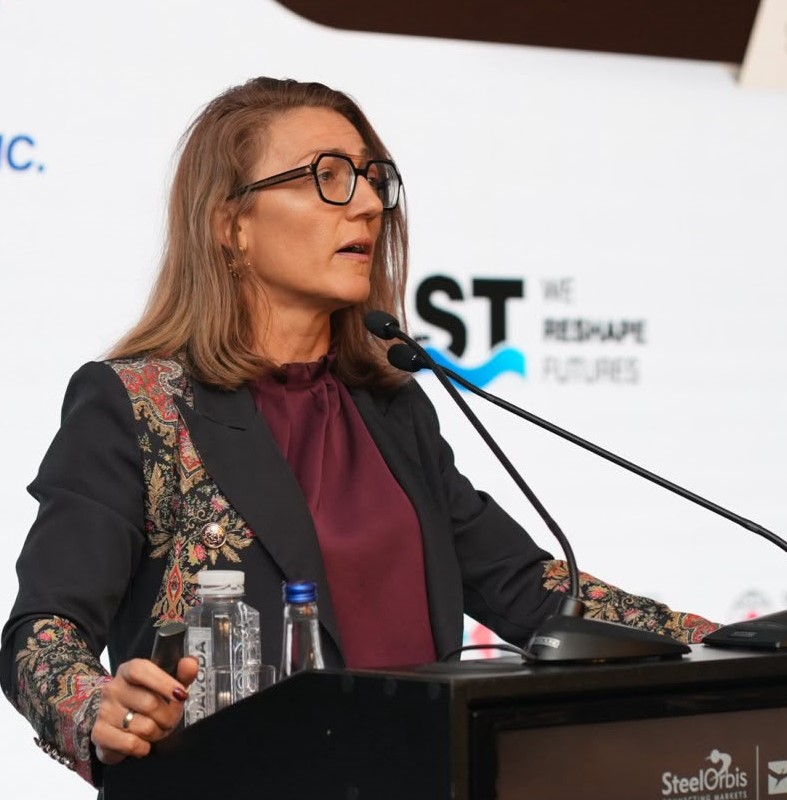
Geopolitical fragmentation is reshaping global steel trade, with market access, supply chain reliability and regulatory compliance becoming increasingly important competitive factors alongside production costs and prices, according to geopolitical strategist and FACE founder Velina Tchakarova, speaking at the SteelOrbis 2026 Fall Conference & 95th IREPAS Meeting held in Belgrade on September 27-29. Ms. Tchakarova stated that steel has become a strategic asset rather than merely a tradable commodity, as geopolitical competition increasingly extends to tariffs, sanctions, export controls, energy, logistics and financial systems.
Excess capacity and trade barriers reshape global flows
Ms. Tchakarova highlighted the combination of rising global excess steel capacity and increasing trade barriers as a major challenge. According to the data presented, global excess steelmaking capacity is expected to increase from around 640 million mt to 745 million mt by 2028, while the number of trade barriers has increased fivefold.
She stressed that protectionist measures may support margins in individual markets, but they do not eliminate surplus capacity or create additional demand. Instead, excess volumes are redirected toward markets which remain accessible.
China is central to this trend, she noted. Chinese steel exports reached 131.2 million mt in 2025, representing 40.8 percent of global exports, while 207 trade restrictions across 62 countries are currently aimed at defending domestic steelmaking capacities.
Steel trade is becoming increasingly dependent on requirements beyond price. Tariffs and quotas, melt-and-pour and origin rules, carbon regulations such as CBAM, sanctions, banking requirements, vessel eligibility and route reliability can all determine whether a transaction is possible. “Competition is now measured in tonnes that also clear customs, not tonnes that leave the mill,” Ms. Tchakarova stated.
Europe faces rising demand but lower domestic output
Europe illustrates the growing tension between protection and import dependence. Ms. Tchakarova stated that European steel demand increased by 4.4 percent in 2025, while domestic production declined by 2.9 percent. Imports supply approximately 30 percent of demand, while around 75 percent of the region's iron ore and coking coal requirements are sourced from abroad.
Reminding the EU's new steel trade regime and CBAM, Ms. Tchakarova stressed that protection can translate into greater resilience only if it is supported by competitive domestic production, including adequate energy, investment, financing and reliable raw material supplies.
Compliance and reliability to define competitiveness
More broadly, Tchakarova said she expects the steel market to evolve into overlapping trading systems rather than completely separate blocs. Low-carbon, traceable and admissible steel is likely to target premium markets, while protected regional markets increasingly favor domestic or allied production.
In this environment, Tchakarova concluded that the lowest-cost steel will not necessarily have the competitive advantage. Instead, the ability to provide traceable, compliant, financeable, insurable and reliably deliverable steel will increasingly determine market access.