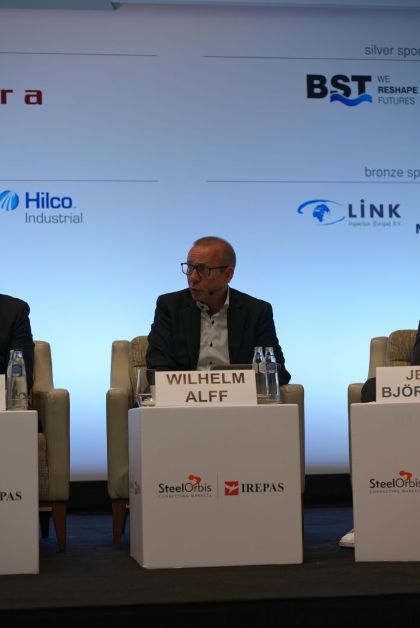
Speaking during the panel session on the last day of the SteelOrbis 2026 spring Conference & 94th IREPAS Meeting held in Amsterdam on April 26-28, Wilhelm Alff, director at Duferco and chairman of the traders committee, shared the committee’s assessment of current market conditions, highlighting weakening demand, regulatory pressures and rising geopolitical risks.
According to the committee, crude steel production in China reached around 960 million mt in 2025, while data from the first quarter of 2026 indicate that output may decline further or at best remain stable, with no clear signs of growth. In China, the sharpest drop was observed in the rebar segment, in which production fell by 12 percent, reflecting the ongoing downturn in the construction sector. The only improvement in China was the growth of more than 10 percent in iron ore inventories, mainly due to strategic stock building, highlighting the disconnect between raw material positioning and weak end-user demand.
This weakness in demand is particularly evident in Europe, where the overall economic outlook remains poor. Public spending is increasingly being redirected toward defense and social support rather than infrastructure, especially in Germany, limiting the recovery potential for steel consumption. The committee also pointed out that existing production capacity in the EU continues to exceed demand, noting that even prolonged production stoppages by major producers have had little visible impact on the market.
CBAM and safeguard measures increase pressure on trade
A key concern for traders remains the implementation of the EU’s Carbon Border Adjustment Mechanism (CBAM). The committee chairman emphasized that, in the current environment, traders are advised to use default emission values when calculating CBAM costs in order to avoid risks, although this approach increases cost exposure. Uncertainty surrounding calculation methods and verification procedures continues to complicate transactions, making it essential to involve producers and clearly define contract terms.
In addition, recent changes to the EU safeguard system have added further pressure. Quotas have been reduced by nearly 50 percent, while out-of-quota duties may rise to as high as 50 percent. Market participants criticized the lack of adjustment in country-specific quotas, even where suppliers have not delivered material for extended periods. As a result, portions of the quota system remain effectively unusable, further tightening supply and negatively affecting buyers and end-users in the region.
Geopolitical tensions disrupt supply chains and raise costs
Against this backdrop, traders also highlighted the growing impact of geopolitical tensions, particularly in the Middle East. According to Mr. Alff, escalating tensions have tightened raw material supply chains and pushed costs higher, significantly slowing trading activity. Mills are increasingly relying on short-term sourcing strategies and opportunistic cargoes, while additional costs for transporting billets overland from Omani ports are estimated at around $40/mt. Severe port congestion is further complicating trade flows, making execution increasingly difficult.
Despite these disruptions, the committee believes that the current situation is still being treated as temporary rather than structural. However, logistical constraints, especially in key maritime routes, continue to limit cargo movements and add uncertainty to global trade.
Shifting trade flows and uncertain outlook
Commenting on global trade flows, Mr. Alff noted that exporters are likely to face growing challenges in accessing traditional markets. Tightening EU quotas and rising protectionism are forcing suppliers to seek alternative destinations, though options are becoming increasingly limited as more countries introduce similar trade barriers. Africa is expected to remain a key growth market in the medium term, supported by rising imports from Asia, particularly China, although the expansion of local production capacity and potential protectionist measures could gradually slow this trend.
Regarding China, the committee expects semi-finished steel exports to remain at elevated levels but under tighter control, as the Chinese authorities are likely to manage trade flows more actively to avoid another sharp surge. While the ongoing crisis in the Gulf region could support demand for Chinese material, its impact will largely depend on logistical conditions and the ability to move cargoes efficiently.
Looking at other regions, market conditions in the US and Latin America were described as relatively stable, with the US benefiting from solid demand driven by public infrastructure projects.
Overall, the traders committee underlined that the global steel market is entering a period of heightened uncertainty, shaped by weak demand in key regions, regulatory changes and geopolitical risks. In such an environment, Alff concluded that it is extremely difficult to predict price trends, emphasizing that market participants will need to continuously monitor developments and adjust their strategies accordingly.