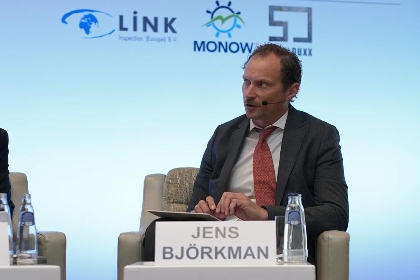
On the last day of the SteelOrbis 2026 Spring Conference & 94th IREPAS Meeting held in Amsterdam on April 26-28, speaking at the panel session, Jens Björkman from Stena Metal International and also chairman of the raw material suppliers committee, shared the committee’s assessments of the current dynamics and difficulties in the global raw material markets.
Mr. Björkman highlighted significant shifts in global market dynamics over the past year, pointing to tighter supply conditions, changing trade flows and increasing geopolitical influence on pricing and demand.
China’s production slowdown supports global sentiment
One of the key developments has been the slowdown in Chinese steel output, with March production falling to the lowest monthly level in six years.
This decline, linked to weaker margins and stricter controls, has supported sentiment in other regions, while iron ore prices have remained relatively firm at $105-110/mt due to supply-side constraints.
India continues to stand out as a major growth market, supported by strong domestic sponge iron production. This has reduced its reliance on scrap imports, although the country could be an attractive destination, based on freight costs and pricing conditions.
Protectionism shapes European market, US market turns inward
The chairman of the raw material suppliers committee stated that, in Europe, safeguard measures and regulatory frameworks have reinforced protectionist dynamics, supporting intra-regional scrap demand. However, concerns persist over high energy costs and the risk of stagflation, which could weigh on longer-term demand.
In the United States, stronger domestic steel production has boosted internal demand for raw materials. At the same time, the attractiveness of scrap exports has declined, particularly for high-quality grades, as supply increasingly shifts toward domestic consumption.
Turkey drives scrap demand and prices
Mr. Björkman pointed out that Turkey has seen improved sentiment, supported by stronger steel production and demand. Reduced semis supply from Iran has increased reliance on scrap imports, pushing prices to around $410/mt, an annual high.
Rising freight costs, driven by higher bunker fuel prices and disruptions of oil shipments through the Strait of Hormuz, have further supported pricing.
No scrap supply surplus globally
Björkman emphasized that there is no global surplus of scrap supply, as scrap continues to be steadily consumed. Europe exports around 19-20 million mt annually, reflecting limited domestic demand growth, but future availability may tighten due to increasing EAF adoption and regulatory constraints.
Traditional importers in the Middle East may face challenges as scrap availability tightens in Europe and the US. Meanwhile, he noted, growing scrap generation and processing capacity in Asia, particularly in China and India, could gradually reshape global trade flows.
Outlook remains uncertain
Björkman said that increasing regulatory requirements, particularly EU waste shipment rules, are expected to drive investment in sorting and processing. At the same time, tighter credit conditions and reduced availability of trade finance are adding complexity to global scrap trade.
He went on to say that, despite strong pricing and demand conditions, the market outlook remains uncertain. Energy prices, economic growth and geopolitical developments continue to pose risks, while elevated oil prices at around $110 per barrel are still considered manageable for now. However, in conclusion, he commented that any deterioration in demand or purchasing power could quickly shift the market into a more challenging phase.