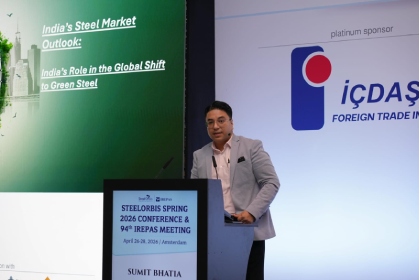
Speaking at the SteelOrbis 2026 Spring Conference & 94th IREPAS Meeting, Sumit Bhatia, vice president, new business development & strategy, at ARS Steels, emphasized that global steel competitiveness is undergoing a structural shift, with access to scrap becoming increasingly decisive.
Mr. Bhatia noted that scrap availability is tightening globally as exports remain concentrated in a limited number of regions, while major suppliers such as the US, EU and Japan are increasingly prioritizing domestic consumption. More than 60 countries have already introduced restrictions on scrap exports, and availability is expected to decline further toward 2030.
Demand growth to reshape raw material needs
The ARS Steels official stated that global steel demand is projected to rise from around 1.8 billion mt to 2.6-2.7 billion mt by 2070, with growth led by India, Southeast Asia and Africa, while China’s contribution is stabilizing due to structural weakness in its property sector.
He added that, at the same time, the production mix is expected to shift significantly. The share of blast furnace-based production, currently dominant, is set to decline, while the electric arc furnace and induction furnace routes are projected to expand to around half of total output by 2070, driven by decarbonization policies and raw material constraints.
Carbon policies reshaping trade dynamics
Mr. Bhatia stressed that steel trade is increasingly influenced by carbon regulation. The EU Emissions Trading System imposes direct carbon costs on producers, while CBAM extends these costs to imports, effectively reshaping competitiveness.
He pointed out that high-carbon steel is losing market access, while low-carbon steel is gaining a pricing advantage, marking a transition from cost-driven to carbon-driven trade dynamics.
India’s steel growth accelerates
India is expected to remain a key growth engine, Mr Bhatia said, adding that its crude steel output is projected to reach 165 million mt in the 2026-27 financial year and rise to 223 million mt by 2030-31, representing strong expansion.
This growth is driving increased demand for raw materials including iron ore, coking coal, DRI and particularly scrap, which is becoming strategically important in the transition to sustainable steelmaking.
Structural scrap deficit widens
He noted that, despite rising demand, India’s scrap utilization remains below the global average, reflecting structural limitations in domestic supply and recycling infrastructure. Total scrap consumption stands at around 41 million mt, and the country’s deficit is expected to widen significantly, potentially reaching 40-45 million mt by 2040, ensuring continued reliance on imports.
Bhatia said that recent market developments indicate tightening supply conditions. Imported scrap prices have risen faster than domestic prices, while domestic price increases have been supported by constrained supply and operational disruptions. India’s metallic mix remains largely dependent on DRI, he stated, with scrap playing a complementary but increasingly important role as the transition toward lower-emission production progresses gradually.
He went on to say that coking coal demand continues to rise alongside steel production, with import dependence remaining high. Australia remains the dominant supplier, though other sources are gaining market share.
Decarbonization pathways still evolving
Bhatia said that the role of green hydrogen in steelmaking remains limited in the near term, with relatively modest emissions reductions achieved under current applications. He added that India has introduced a green steel classification system based on emissions intensity, aiming to create a structured framework for evaluating and promoting lower-carbon production.
Policy support and recycling initiatives
Government initiatives such as the National Steel Scrap Recycling Policy, the Vehicle Scrappage Policy, and ship recycling regulations are supporting scrap generation and positioning India as a major player in global recycling activity, Bhatia noted.
At the same time, the National Green Hydrogen Mission aims to scale up hydrogen production and renewable energy capacity, supporting long-term decarbonization goals.
In conclusion, Mr. Bhatia stated that the global steel market is moving toward a carbon-driven structure. Scrap availability is expected to tighten structurally, trade flows will increasingly be shaped by policy, and competitive advantage will depend not only on cost efficiency but also on access to low-carbon raw materials.