Speaking at the World Steel Association’s (worldsteel) Open Forum in Brussels on June 2 and 3, 2026, Åsa Ekdahl, director of communications and climate advocacy at worldsteel, outlined how the steel industry's decarbonization journey is becoming increasingly shaped by regional differences in energy availability, infrastructure, policy frameworks and competitiveness considerations.
According to Ekdahl, steel remains a foundational material for climate-resilient infrastructure, low-carbon manufacturing, renewable energy systems, transportation and broader decarbonization efforts across the global economy.
Worldsteel estimates that in 2024 each metric ton of steel produced generated an average of 2.18 mt of CO₂ equivalent (CO₂e) across Scopes 1, 2 and 3 emissions. With global steel production reaching 1.886 billion mt in 2024, total sector emissions were estimated at approximately 4.1 billion mt of CO₂e. According to worldsteel, the industry remains one of the largest industrial sources of greenhouse gas emissions globally.
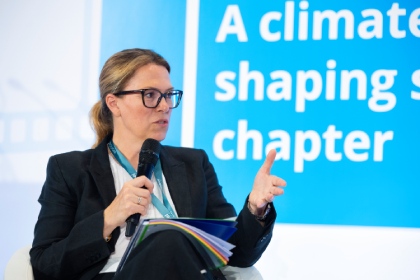
Decarbonization priorities are changing
Ekdahl noted that the broader context for industrial decarbonization has evolved significantly in recent years. While climate action remains a key objective, it is increasingly being balanced against energy security, industrial competitiveness, supply chain resilience, and economic growth considerations. As a result, different regions are pursuing different transition strategies depending on local circumstances and resource availability.
She highlighted several challenges that have emerged since earlier decarbonization roadmaps were developed, including slower-than-expected hydrogen deployment, infrastructure bottlenecks, rising financing costs, higher energy prices, uneven policy support, and delays and rephasing of major projects
Multiple emission-reduction pathways emerging
According to Ekdahl, the industry's transition is moving from theoretical planning toward practical implementation. Key emission-reduction levers expected to contribute between 2025 and 2050 include electrification and scrap optimization, hydrogen-ready DRI, carbon capture storage on blast furnaces, hydrogen smelting reduction or fluidized bed routes, and novel chemistry.
Energy and infrastructure now viewed as primary constraints
One of the key conclusions presented by Ekdahl was that the industry's main challenge for 2030 is no longer technology availability. Instead, the primary bottlenecks are access to affordable low-carbon electricity, grid infrastructure, renewable energy deployment, hydrogen supply networks, and carbon transport and storage infrastructure. It was noted that many low-carbon steelmaking technologies have already moved beyond the validation stage and are now entering early commercial deployment.
Blast furnace technology remains central
Despite growing investment in alternative technologies, Ekdahl emphasized that the blast furnace remains the dominant ironmaking route globally and is expected to continue playing a major role for many years. Practices being developed to reduce its carbon footprint include top gas recycling, lower-carbon and circular reductants, direct and indirect hydrogen use, electrification, plasma injection, oxyfuel injection, digitalization, and carbon capture, storage and use.
Electricity becoming a strategic competitiveness factor
Ekdahl highlighted that steelmaking economics are gradually shifting from dependence on globally traded coal toward reliance on locally priced electricity. As a result, regional differences in electricity prices are expected to become increasingly important. Affordable low-carbon electricity is emerging as a critical determinant of future steel industry competitiveness, particularly for producers investing in DRI-EAF production routes and electrified processes.
Supply chains and business models continue to evolve
The presentation also highlighted broader structural changes occurring across the steel ecosystem. These include growth of green iron production, increased investment in scrap processing and recycling, new partnerships and joint ventures, expansion of supply-chain collaboration, emerging demand-side policies, new financing models and development of low-carbon steel markets. At the same time, accounting and emissions-reporting standards are moving toward greater harmonization and interoperability as regulatory requirements expand and customers seek greater transparency.
Ekdahl concluded that there is unlikely to be a single global pathway for steel decarbonization. Instead, the transition is increasingly expected to follow region-specific models shaped by local energy resources, infrastructure availability, policy support mechanisms, raw material access and industrial competitiveness considerations.