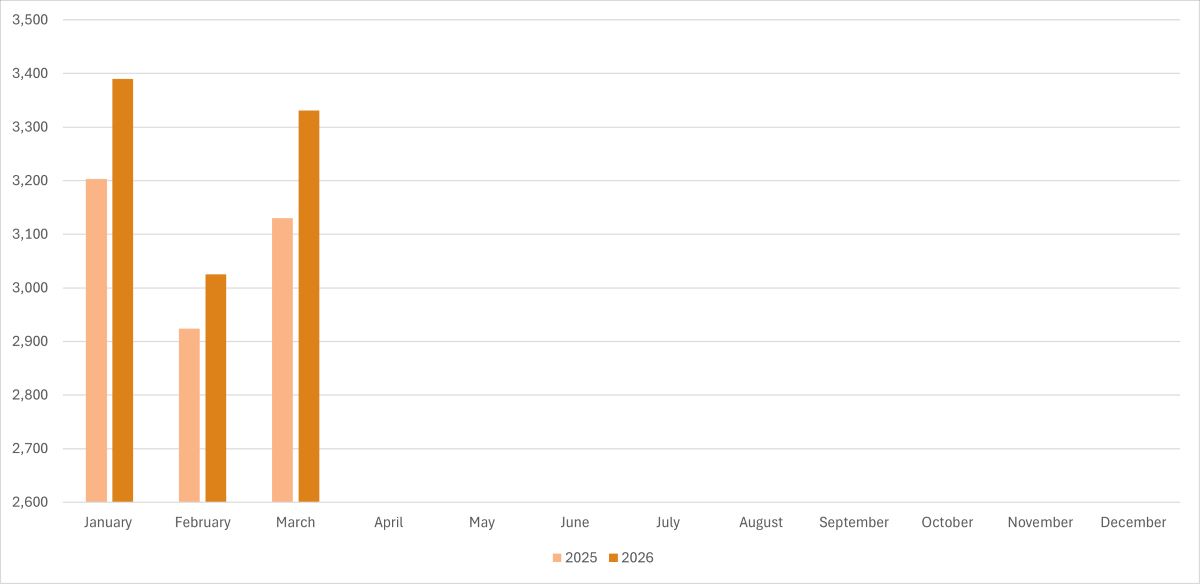
According to a statement released by the Turkish Steel Producers’ Association (TCUD), in March this year crude steel production increased by 6.4 percent year on year to 3.3 million mt in Turkey, being the world’s eighth largest steelmaking country, while in the first quarter production rose by 5.3 percent year on year to 9.7 million mt. In March, Turkey’s billet and slab production amounted to 1.88 million mt and 1.45 million mt, down 4.6 percent and up 25.1 percent year on year, respectively. In the January-March period, Turkey produced 5.74 million mt of billet, down 1.6 percent, against 3.99 million mt of slab, up 17.1 percent, both compared to the same period of 2025.
In the given month, finished steel consumption in Turkey rose by 20.9 percent year on year to 3.3 million mt, while in the January-March period the country’s finished steel consumption increased by 8.9 percent year on year to 9.9 million mt.
In March, Turkey’s steel exports rose by five percent to 1.5 million mt, while the value of these exports increased by 0.5 percent to $1 billion, year on year. In the first three months, the country’s steel exports declined by 6.8 percent to 3.5 million mt, while the value of these exports decreased by 9.4 percent to $2.3 billion, both year on year. Flat and long product exports in the January-March period amounted to 1.4 million mt and 1.86 million mt, respectively, with decreases of 10.5 percent and 9.1 percent year on year, while semi-finished product exports amounted to 247,787 mt, up by 63.6 percent year on year.
In March, Turkey’s steel imports increased by 38.2 percent to 1.6 million mt, while the value of these imports moved up by 23.4 percent to $1.1 billion, both year on year. In the January-March period, the country’s steel imports increased by 2.6 percent to 4.3 million mt, while the value of these imports moved down by 1.5 percent to $3 billion, both year on year. Looking at the imported products, flat and long product imports in the first three months amounted to 2.07 million mt and 349,601 mt, respectively, with an increase of 1.1 percent and a decrease of 2.8 percent year on year, while semi-finished product imports amounted to 1.91 million mt up by 5.4 percent year on year.
In the first quarter, Turkey’s steel export to import ratio decreased to 77.7 percent, from 84.5 percent recorded in the same period of the previous year.
According to the TCUD, as tensions in the Middle East reshape global supply chains, the more cautious approach of Chinese producers toward orders due to cost pressures has opened a new window of opportunity for Turkey. Geographical proximity and quality advantages have made Turkish-origin steel more visible in the European market, while shifts in demand similar to those seen in past crisis periods have re-emerged. However, the sharp increase in scrap and energy prices, along with rising freight and insurance costs, is putting upward pressure on production costs.
According to the statement, scrap prices approaching $400/mt in global markets have become a significant pressure factor narrowing producers’ margins. Meanwhile, new regulations in the EU aimed at restricting imports have come to the forefront as one of the sector’s main agenda items. TCUD emphasized that at a time when protectionism is rapidly spreading across both developed and developing countries in the steel sector, it is important for Turkey to more actively protect its steel industry against dumped imports.