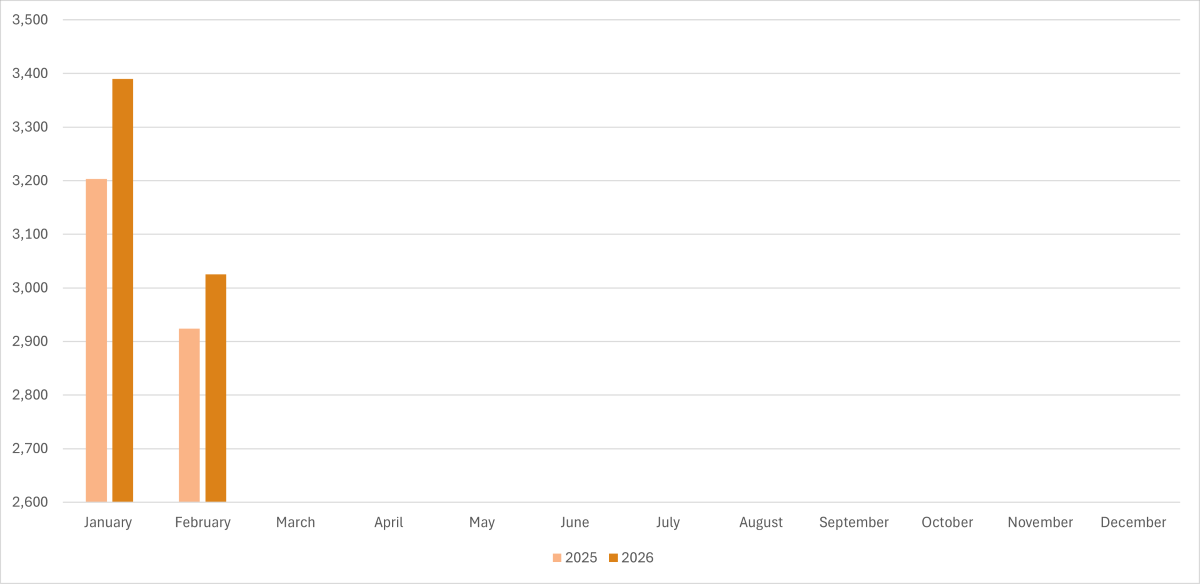
According to a statement released by the Turkish Steel Producers’ Association (TCUD), in February this year crude steel production increased by 3.4 percent year on year to 3.20 million mt in Turkey, maintaining its position as the world’s seventh largest steelmaking country, while in the first two months production rose by 4.7 percent year on year to 6.41 million mt. In February, Turkey’s billet and slab production amounted to 1.79 million mt and 1.23 million mt, down 4.9 percent and up 18.6 percent year on year, respectively. In the January-February period, Turkey produced 3.86 million mt of billet, down 0.1 percent, against 2.55 million mt of slab, up 12.9 percent, both compared to the same period of 2025.
In the given month, finished steel consumption in Turkey rose by 11.3 percent year on year to 3.19 million mt, while in the January-February period the country’s finished steel consumption increased by 4.1 percent year on year to 6.7 million mt.
In February, Turkey’s steel exports fell by 8.6 percent to 1.1 million mt, while the value of these exports decreased by 9.2 percent to $714.8 million, year on year. In the first two months, the country’s steel exports declined by 13.5 percent to two million mt, while the value of these exports decreased by 15.2 percent to $1.3 billion, both year on year. Flat and long product exports in the January-February period amounted to 764,730 mt and 1.08 million mt, respectively, with decreases of 15.5 percent and 16.9 percent year on year, while semi-finished product exports amounted to 146,574 mt, up by 47.8 percent year on year.
In February, Turkey’s steel imports increased by nine percent to 1.5 million mt, while the value of these imports moved up by 7.2 percent to $1 billion, both year on year. In the January-February period, the country’s steel imports decreased by 10.8 percent to 2.7 million mt, while the value of these imports moved down by 11.7 percent to $1.9 billion, both year on year. Looking at the imported products, flat and long product imports in the first two months amounted to 1.32 million mt and 237,119 mt, respectively, with a decrease of 11.4 percent and an increase of 19.6 percent year on year, while semi-finished product imports amounted to 1.17 million mt down by 14.5 percent year on year.
In the first two months, Turkey’s steel export to import ratio decreased to 69.7 percent, from 72.5 percent recorded in the same period of the previous year.
According to the TCUD, the weakening trend in exports to the EU has become more pronounced. Concerns have increased that this decline may deepen further ahead of the new safeguard measures expected to enter into force on July 1. In the first two months of the year, Turkey’s exports to the EU fell by 36 percent. Similarly, in the Middle East, Turkey’s second-largest export market, demand declined sharply due to geopolitical risks and an economic slowdown, with exports to the region dropping by 38 percent. Although limited increases in exports to South America and CIS countries presented a positive outlook in terms of market diversification, they were not sufficient to offset the losses in major export markets. Weak demand in key markets, price pressure and increasing trade measures limited the impact of growth in alternative markets. Meanwhile, despite a decline in steel product imports in the first two months of the year, imports remained at high levels, and, combined with export losses, the foreign trade deficit continued to widen.
While Europe’s efforts to restructure supply security and further integrate Turkey into a “Made in Europe” approach present an opportunity for Turkish industry, geopolitical risks stemming from the war in the Middle East continue to negatively affect steel trade. The TCUD stated that Turkey’s non-involvement in the war helps minimize its negative impact on the country’s economy and steel sector.
Turkey's crude steel production - February 2026