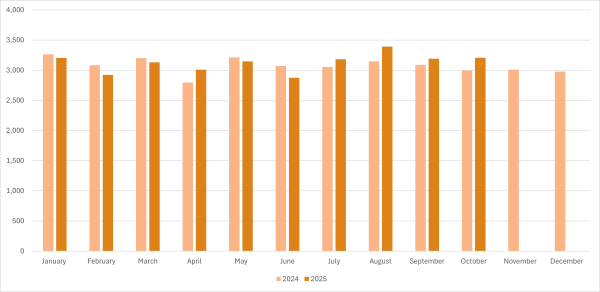
According to a statement released by the Turkish Steel Producers’ Association (TCUD), in October this year crude steel production increased by 3.1 percent year on year to 3.21 million mt in Turkey, the world’s eighth largest steelmaking country, while in the first 10 months production rose by 1.2 percent year on year to 31.27 million mt. In October, Turkey’s billet and slab production amounted to 2.07 million mt and 1.13 million mt, up 9.2 percent and 6.5 percent year on year, respectively. In the January-October period, Turkey produced 19.88 million mt of billet, up 4.7 percent, against 11.39 million mt of slab, down 4.4 percent, both compared to the same period of 2024.
In the given month, finished steel consumption in Turkey rose by 7.2 percent year on year to 3.31 million mt, while in the January-October period the country’s finished steel consumption increased by 2.6 percent year on year to 32.18 million mt.
In October, Turkey’s steel exports rose by 18.7 percent to 1.17 million mt, while the value of these exports increased by 8.2 percent to $785.69 million, year on year. In the first 10 months, the country’s steel exports rose by 12.6 percent to 12.54 million mt, while the value of these exports increased by 4.1 percent to $8.49 billion, both year on year. Flat and long product exports in the January-October period amounted to 5.48 million mt and 6.57 million mt, respectively, with increases of 11.0 percent and 10.9 percent year on year, while semi-finished product exports amounted to 497,600 mt.
In October, Turkey’s steel imports decreased by 10.8 percent to 1.49 million mt, while the value of these imports moved down by 14.1 percent to $1.02 billion, both year on year. In the January-October period, the country’s steel imports increased by 13.8 percent to 15.65 million mt, while the value of these imports moved up by 1.6 percent to $10.92 billion, both year on year. Looking at the imported products, flat and long product imports in the first 10 months amounted to 7.49 million mt and 1.26 million mt, respectively, with increases of 11.4 percent and 15.6 percent year on year, while semi-finished product imports amounted to 6.88 million mt.
In the first 10 months, Turkey’s steel export to import ratio increased to 77.76 percent, from 75.89 percent recorded in the same period of the previous year.
According to the TCUD, the increase in Turkey's steel exports during the first half of this year slowed to only one percent in the third quarter, due to shrinking demand in steel markets, particularly in the EU, and intensified import pressure from Russia, China, and other Far Eastern countries. On the other hand, the country’s steel imports rose by 27.5 percent in the same quarter. The association stated that Turkey's steel industry continues to face competitive challenges in both domestic and international markets.
Meanwhile, the sharp rise in housing sales did not reflect into higher rebar consumption, as most sold homes were second-hand units. In October, long steel consumption fell by 8.9 percent, while flat steel consumption declined only 0.1 percent, supported by recent activity in sectors such as automotive.
Since the declines in inflation and interest rates have not yet been reflected in loan costs, a gradual recovery trend in domestic consumption and production is expected to continue over the last two months of the year. Despite ongoing challenges in trade with the EU, 2026 is projected to be a year of faster improvement across key indicators.
Turkey's crude steel production - October 2025