According to a report published by the German Economic Institute (IW Köln), Germany should maintain competitive domestic production in energy-intensive industries such as steel while enabling their transition toward climate-neutral production.
The report stated that energy-intensive industries are currently facing weak demand, global overcapacity and trade policy barriers, while simultaneously being required to carry out a climate-neutral transformation. However, the necessary technical, infrastructural and regulatory conditions for this transformation are not yet sufficiently developed.
IW Köln highlighted the importance of Germany's integrated industrial value chains, noting that pig iron and steel production generated more than €80 billion in intermediate inputs in 2023. While most of these inputs went into steel processing, more than €22 billion were supplied to sectors including metal products, automotive manufacturing and mechanical engineering. According to the institute, weakening individual parts of this interconnected industrial network could affect entire value chains and increase relocation risks.
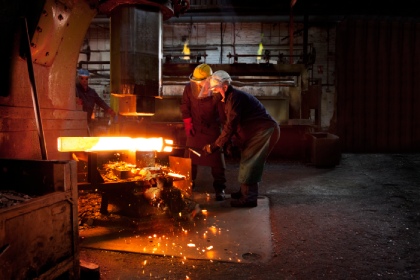
Around 5.5 million jobs linked to steel value chain
The report pointed to the steel industry as a particularly clear example of the challenges facing Germany's energy-intensive sectors. Around 605,000 jobs in Germany depend directly on the steel industry through suppliers and customers, while approximately 5.5 million jobs are linked to steel along the overall value chain.
German crude steel production remained below 40 million mt in 2025 for the fourth consecutive year amid weak domestic and foreign demand as well as substantial global overcapacity. According to IW Köln, Chinese steel producers in particular receive substantial government support, contributing to downward pressure on global steel prices and margins. These economic conditions are making the planned transition toward climate-friendly steelmaking more difficult.
Around half of announced green steel projects face delays
At the same time, the report noted that the development of climate-friendly steelmaking capacity is progressing more slowly than initially anticipated globally, with around half of announced green steel projects experiencing delays. High investment costs, uncertainty regarding hydrogen prices and insufficient offtake agreements are making project financing difficult, including in regions that appear to offer more favorable conditions.
IW Köln argued that production costs alone are not sufficient to determine the future competitiveness of steelmaking locations. Productivity, product quality, delivery reliability, proximity to suppliers and customers, supply-chain risks and expected long-term returns also play an important role.
Domestic steelmaking important for Germany's resilience
The institute also stressed the importance of domestic steel production from a resilience perspective. According to the report, dependence on imported raw materials such as iron ore and coking coal is fundamentally different from dependence on foreign steelmaking capacity. Raw materials can be obtained through global markets and diversified supply sources, while individual steel production facilities and their capacities cannot be replaced at short notice.
IW Köln stated that imports of competitively priced climate-friendly hydrogen, direct reduced iron and other intermediate products could eventually form part of a competitive German steelmaking system. However, German production sites should be given the opportunity to establish their position within these emerging value chains.
IW Köln calls for energy, funding and trade measures
According to the report, reforming the EU Emissions Trading System (EU ETS) alone will not be sufficient to ensure a successful industrial transformation. Additional measures are required, including lead markets for climate-friendly products, competitive energy prices and safeguards during the transition period in which conventional and climate-friendly production processes operate simultaneously.
The institute also called for transformation funds, including resources from Germany's Climate and Transformation Fund, to be consistently directed toward these objectives. In addition, it stressed the need for stronger protection against unfair competitive distortions originating outside the EU and for the further development of the Carbon Border Adjustment Mechanism (CBAM).