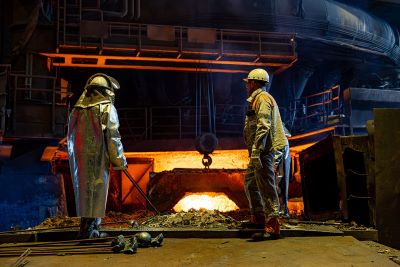
Germany-based steelmaker Salzgitter AG has announced that its subsidiary Hüttenwerke Krupp Mannesmann (HKM) has permanently shut down blast furnace A at its Duisburg plant after more than 53 years of production, as part of its transition toward lower-carbon steelmaking. The final tapping of the furnace took place on September 19.
Blast furnace A was commissioned in 1973 and produced approximately 93 million mt of pig iron over five campaigns during its operating life. A few days before its closure, HKM also shut down coke oven battery No. 2 at its Duisburg plant, as SteelOrbis previously reported.
BF route to be replaced with EAF from 2029
HKM plans to produce lower-carbon steel in Duisburg using a new electric arc furnace (EAF) from 2029. The EAF will have an annual production capacity of up to 2.5 million mt, making it Germany's largest EAF and the second-largest in the EU.
The project is receiving €200 million in funding from Germany's federal government and the state of North Rhine-Westphalia under the Federal Funding for Industry and Climate Protection program. Construction of the project started in August this year, while completion is scheduled for 2029.
Gunnar Groebler, Salzgitter CEO, said the closure represents another step toward the group's goal of completing its transition to nearly carbon-neutral steel production by the mid-2030s. The company plans to replace the conventional blast furnace route in Duisburg with EAF-based production as part of this strategy.
Blast furnace B to maintain production during transition
Until the new EAF is completed, blast furnace B will maintain production at the Duisburg site. The furnace was restarted several weeks ago following a refurbishment lasting several months.
HKM's two blast furnaces produced approximately four million mt of pig iron in 2025. Due to the refurbishment of blast furnace B and the permanent shutdown of blast furnace A, pig iron production is expected to decline to around three million mt in 2026. From 2027, HKM's annual production capacity will stand at up to 2.5 million mt, initially using one blast furnace and subsequently the new EAF.