The Global Forum on Steel Excess Capacity (GFSEC) has announced that it has agreed on a new Comprehensive Framework for Joint Action aimed at addressing the worsening global steel excess-capacity crisis, following its ministerial meeting held in Milwaukee, Wisconsin, on September 30 under the chairmanship of the US.
Ministers and senior representatives from GFSEC members stated that global steel excess capacity continues to increase despite trade remedies and other measures implemented individually by member countries. They agreed that further collective action is required to establish more level competitive conditions for their domestic steel industries.
Under the new framework, GFSEC members intend to implement concrete measures through their respective national legal systems, taking into account national circumstances and international commitments. The forum will assess the measures implemented and report on progress at its next ministerial meeting.
The ministers identified non-market policies and practices in certain non-GFSEC economies as a continuing driver of global steel excess capacity. GFSEC and its facilitator were instructed to collect and exchange information on policies and practices considered to distort competition and trade and to identify possible measures to address them and their underlying causes.
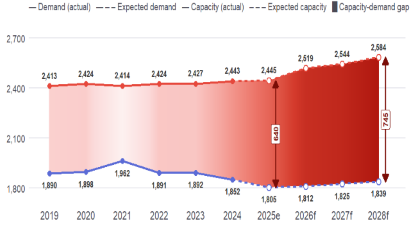
Global steel excess capacity projected to reach 745 million mt
According to the ministerial statement, global steel excess capacity is projected to increase from 601 million mt in 2024 to 745 million mt in 2028, reaching its highest level in a decade. During 2026-2028, global steel demand is expected to increase by only 34 million mt, while steelmaking capacity could expand by as much as 139 million mt.
They highlighted the role of subsidies and other support measures in certain non-GFSEC economies. According to OECD data cited in the statement, a typical Chinese steelmaker receives grants, tax concessions and below-market financing equivalent to approximately 15 times the support received by a typical steel company elsewhere relative to asset size, while China's steel subsidy rate has nearly doubled since 2019. In addition, Chinese steelmakers are adding around 70 million mt of steelmaking capacity overseas, particularly in Southeast Asia and Africa, while state-owned enterprises account for 70 percent of Chinese cross-border steel investments.
China's steel exports reached record 131 million mt in 2025
GFSEC linked excess capacity and stagnant Chinese domestic demand with rising exports. China's steel exports reached a record 131 million mt in 2025, up 153 percent compared with 2020 and exceeding the EU's total steel production that year.
The forum stated that global excess capacity is putting downward pressure on steel prices, capacity utilization and profitability. The global steel industry's EBITDA remained below 10 percent of sales in 2024, a level GFSEC considers insufficient to support investment in innovation, resource efficiency and the adoption of best available technologies.
Trade diversion and circumvention risks highlighted
At the same time, the ministers warned that the growing use of trade measures could divert steel shipments towards markets with weaker trade-enforcement mechanisms. GFSEC also highlighted increasing circumvention risks and suspicious changes in trade flows. GFSEC members have initiated 68 antidumping and countervailing-duty measures against China since 2016. In 28 of these cases, Chinese exports of the products concerned to GFSEC economies declined substantially while exports to non-GFSEC economies increased, followed by higher exports of the same products from those economies to GFSEC members.
Against this backdrop, GFSEC members called for stronger trade-enforcement instruments, effective trade measures, greater cooperation in identifying suspicious trade patterns, measures against circumvention and closer policy coordination among participating economies.