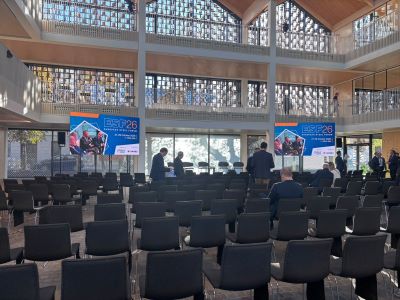
Decarbonization remains central to the transformation of the European steel industry, but the pace of the transition will depend on the availability of competitively priced clean energy, access to raw materials and a regulatory framework that supports investment. This was the key message emerging from the first day of the European Steel Forum, organized by the Association for Iron & Steel Technology (AIST) in cooperation with Danieli, held in Udine on October 27-28.
Participants were welcomed by Giacomo Mareschi Danieli, CEO of Danieli & C. and Rolando Paolone, CEO and CTO of Danieli Group, alongside José Noldin, chair of the AIST European Member Chapter and CEO of GravitHy. The subsequent presentations and panel discussions addressed the main challenges of the transition, linking innovation in production processes to the conditions needed to preserve the competitiveness of European industry.
Steel market enters a period of realignment
Ron Ashburn, executive director of AIST, outlined a period of realignment for the steel market, identifying three factors set to reshape its dynamics. The first concerns the changing rules of globalization: security of supply is becoming increasingly important alongside efficiency, while domestic production and supply chain resilience are being viewed as strategic assets. The second is overcapacity, which fuels trade imbalances and encourages greater reliance on tariffs, trade defense measures and industrial policies. The third concerns the opportunities created by decarbonization, artificial intelligence and electrification, with energy infrastructure and advanced manufacturing expected to support new sources of demand.
Net-zero ambitions: investment continues, but transition timelines lengthen
The first panel, Transformation of the European Steel Industry for Carbon Neutrality, was moderated by Jürgen Cappel, managing director of Cappel Stahl Consulting. Participants included Andrea Bianchi, CTO of Arvedi Group; Thomas Bürgler, CEO of K1-MET; Martin Pei, senior advisor at SSAB; Sebastian Börner, technical project manager for Power4Steel at Stahl-Holding-Saar; and Soeke Helmers, EAF lead at Salzgitter Flachstahl.
The presentations provided an overview of the different approaches being pursued to reduce emissions and modernize production assets. Bianchi highlighted Arvedi's commitment to combining decarbonization with product quality, outlining its ESP production model, which can produce 2.8 million metric tons of hot rolled coil annually. The discussion also covered voestalpine's Hy4Smelt demonstration project and the HYBRIT technology for hydrogen-based direct reduced iron production, presented by Pei. Börner and Helmers provided updates on their respective plant transformation programs.
The discussion then focused on hydrogen's role as a reducing agent in steel production and the challenges affecting its large-scale use. While acknowledging that achieving carbon neutrality will take longer, participants reaffirmed their commitment to continued investment. “We will continue investing to replace blast furnaces with electric arc furnaces and expand our opportunities to use sustainable inputs,” Pei stated. Bianchi emphasized the complexity of the current situation: “We are at a crucial stage. Achieving carbon neutrality is difficult, and carbon capture still appears impractical. But we will not give up.”
Another topic was how to reconcile low-emission production targets with the continued use of carbon-intensive processes during the transition. Presenting Power4Steel, Börner described a program combining the construction of new plants with the transformation of existing assets, stressing the need for a pragmatic approach. “We need to find a way to produce green energy: the more clean energy we have available, the more green steel we will be able to produce,” he said.
Marcegaglia: decarbonizing without undermining European competitiveness
The relationship between the transition and competitiveness was explored further in the following presentation, during which Antonio Marcegaglia stressed a key principle for the sector: decarbonization must not lead to deindustrialization.
Noting that emissions reductions have coincided with declining production, Marcegaglia emphasized the need to set technologically achievable targets and keep the Emissions Trading System (ETS) focused on its regulatory compliance function, preventing speculative and financial considerations from taking precedence.
On trade, Marcegaglia welcomed the recent safeguard measures but called for their coordinated and pragmatic implementation. An excessively isolated market, he noted, could encourage indirect steel imports through finished products and components, while also limiting export opportunities for European companies. In his view, the Carbon Border Adjustment Mechanism (CBAM) should likewise retain its role in balancing the costs of the transition. “I believe that CBAM, a measure intended to offset the additional decarbonization costs incurred by European producers, should not become a protectionist tool,” he stated. Excessive steel price increases could undermine the competitiveness of downstream industries, encouraging purchases of imported components outside the mechanism's scope and reducing the industrial value added generated in Europe.
Clean energy: costs, availability and industrial policies at the heart of the transition
Energy dominated the second panel, Carbon-Free Energy Sources for the European Industry, moderated by Susanne Michelic of Montanuniversität Leoben. Participants included Alexander Fleischanderl of Primetals Technologies, Gabriele Imparato of Unicalce, Lutz Weber of Alpacem, Gabriele Guastaferro of Danieli Green Metal and Christian Koulic of TotalEnergies.
The participation of representatives from the lime and cement sectors broadened the discussion to the interdependencies between energy-intensive industries. Imparato noted that approximately one-third of global lime production is destined for the steel industry, while Weber highlighted the complementary roles of cement and steel in infrastructure construction. The transition therefore requires coordination across several value chains that share energy needs and decarbonization challenges. Koulic summarized the issue through the so-called “energy trilemma”: ensuring that energy is affordable, sustainable and reliable at the same time.
The discussion highlighted the need to complement technological development with regulatory and financial conditions that enable projects to move forward. “Technology does not appear to be the problem. We need to create a system that gives us a clear direction in terms of regulation and investment,” Imparato observed.
Guastaferro added that the availability of market-ready solutions represents only part of the journey: to complete the decarbonization process, these technologies must be adopted widely enough to become industry standards. In this context, he highlighted the role of institutions and investment support mechanisms, citing the industrial heat auctions planned under the EU Innovation Fund.
Raw materials: quality and availability reshape the future of steel production
The day concluded with the panel Where and How Will Iron Be Made? Rethinking Feedstock and Geography in a Decarbonizing Steel Industry, which examined changes in raw materials and production geography. Moderated by Felix Firsbach of Badische Stahl-Engineering, the discussion brought together Naota Furihata of Mitsui, Thomas Brown of Binding Solutions, Thiago Campos of SMS group and Jan Eisbacher-Lubensky of Montanuniversität Leoben.
Furihata outlined the outlook for trade in direct reduced iron and hot briquetted iron (DRI/HBI), reporting global trade volumes of 12.4 million metric tons, compared with 79 million metric tons for scrap. According to the estimates presented, the situation is expected to remain relatively balanced through 2030, with developments depending on the availability of high-quality scrap and demand generated by new steelmaking projects.
Brown also outlined growth prospects for pellets, indicating a potential production volume of 190 million metric tons if all announced projects are implemented. Campos, meanwhile, drew attention to the increasing difficulty of sourcing high-grade iron ore, highlighting the need to develop and adopt technologies capable of processing low-grade material effectively.
“Decarbonization is not just about the energy transition; it also presents a challenge in terms of raw material quality,” Campos explained, adding that production solutions will need to be adapted to the resources and conditions of individual regions.
Decarbonization and competitiveness: advancing the transition across the value chain
The first day of the European Steel Forum highlighted a shared direction, alongside calls for a more practical approach to transition timelines and support mechanisms. Companies remain committed to investing in lower-emission processes, but the deployment of new technologies continues to depend on clean energy availability, access to suitable raw materials and the economic viability of projects. For the European steel industry, the challenge will be to advance these elements together through closer cooperation across value chains and an industrial policy framework that reconciles climate targets with continued production and competitiveness.