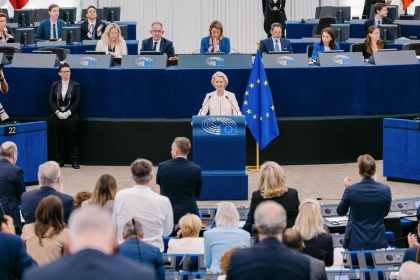
European Commission President Ursula von der Leyen has outlined a series of initiatives aimed at addressing challenges facing European industry, including high energy prices, global competition, trade imbalances and dependence on imported critical raw materials, in her State of the Union speech delivered on September 16, 2026.
According to von der Leyen, economic growth and competitiveness remain key EU priorities. Of the 65 initiatives included in the Competitiveness Compass, 54 have been adopted by the College since the beginning of 2025. Work will continue under the One Europe, One Market Roadmap, including in the areas of capital markets, energy grids, the proposed EU Inc. regime and public procurement.
EU seeks lower energy costs and faster grid investment
Von der Leyen stressed that Europe cannot remain an industrial powerhouse while facing structurally high energy prices. Although the EU has diversified its energy supplies and increased investment in renewable and nuclear energy, she stated that the closure of the Strait of Hormuz had again highlighted Europe's dependence on imported fossil fuels. Since the beginning of the conflict, imported fossil fuels have reportedly cost Europe an additional €90 billion without providing additional energy volumes. The EU therefore plans to increase the availability of affordable and domestically produced clean energy, including renewables, nuclear power and biomethane.
It aims to double electricity's share of energy consumption by 2040, which von der Leyen said could reduce the EU's annual fossil fuel import bill by €260 billion. More than 80 GW of renewable capacity was installed in the previous year, while six times that amount is awaiting grid connection. Von der Leyen consequently called for faster grid investment and connections, additional energy storage and the urgent adoption of the grids package.
Trade imbalance and critical raw material dependence addressed
Regarding trade, von der Leyen stated that the EU's trade deficit with China has reached €1 billion per day and linked the imbalance to deindustrialization in European industrial regions. While the EU is engaged in talks with China to rebalance trade relations, she said it is prepared to use available instruments if these discussions fail to produce results. Europe also remains heavily dependent on China for critical raw materials, with dependence exceeding 80 percent for many materials and reaching 90 percent for some rare earths. The EU therefore plans to establish a European Corporation on Critical Raw Materials to procure and stockpile materials required for sectors including electric vehicles, semiconductors, batteries, clean technologies and defense.
Meanwhile, the EU will seek to ensure a level playing field for European companies. Von der Leyen emphasized that the EU is prepared to respond, including through new instruments, when countries create unfair trading conditions for the EU. In addition, the proposed DiversifyEU package will seek to diversify European supply chains and economic relations. At the same time, it plans to create additional opportunities for European companies by strengthening trade relations with economies across the Americas, Asia, Africa and the Gulf.
EUROFER calls for measures supporting European steel production
Meanwhile, the European Steel Association (EUROFER) welcomed von der Leyen's focus on competitiveness, affordable energy and a level playing field, stating that these conditions are essential to maintaining steel production and industrial investment in Europe. EUROFER called for lower electricity costs, affordable hydrogen, stronger lead markets for low-carbon steel produced in Europe and an EU Emissions Trading System (ETS) framework aligned with industrial conditions. The association also wanted the European Commission's Steel and Metals Action Plan to be implemented throughout the steel value chain.
EUROFER director general Axel Eggert stated that European steelmakers remain committed to climate neutrality, but that investment in low-carbon technologies requires a viable business case. The association also argued that valuable secondary raw materials should remain within the EU instead of being exported to countries without comparable climate ambitions or export restrictions.
Regarding the EU ETS and Carbon Border Adjustment Mechanism (CBAM), EUROFER stated that the pace of the phase-out of free ETS allowances should reflect CBAM's effectiveness in preventing carbon leakage as well as European steelmakers' access to the energy and technologies needed for competitive decarbonization. EUROFER also warned that higher carbon costs could shift carbon leakage risks downstream through increased imports of steel-intensive finished products from countries operating under different carbon and trade conditions. Accordingly, it called for stronger protection for relevant downstream products and Made-in-Europe criteria supporting investment in low-carbon European steel production.