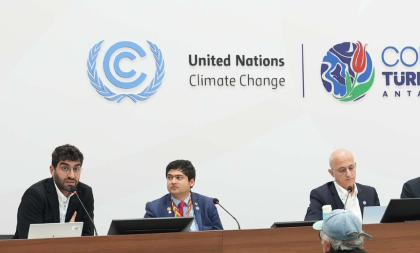
Clean energy infrastructure, predictable demand and binding policy signals must accompany technology investment to advance steel decarbonization, speakers said at the 31st United Nations Climate Change Conference (COP31) panel “Next Steps in Industrial Decarbonization: Progress in Global Steel and Cement Initiatives”.
Moderating the session, Ümit Şahin, head of the Istanbul Policy Center's (IPC) Climate Change Program, said near-zero emission steel and cement require more than $500 billion in investment between 2026 and 2035. However, projects representing less than $20 billion have reached final investment decisions.
Global initiatives shift from ambition to project implementation
Sarbjit Pal of the United Nations Industrial Development Organization (UNIDO) said the Global Green Industrialization Agenda launched at COP31 aims to bring international efforts across sectors, including steel and cement, under a shared framework.
Countries' needs are shifting from technical assistance and roadmaps toward implementing large-scale projects, Pal stated. Clean energy and infrastructure, financing, public and private procurement, and regulatory barriers must be addressed together. He highlighted Turkey's Industrial Decarbonisation Investment Platform as an example of coordinating investment at country level.
Worldsteel: Scrap-based production alone cannot deliver the transition
Speaking on behalf of the World Steel Association (worldsteel), Hiroyuki Tezuka, a fellow at JFE Steel and chair of JISF's Energy and Technology Committee, said scrap availability and quality constrain steel decarbonization options. More than 90 percent of steel scrap is already recycled globally, while growing demand means approximately 1.4 billion mt of ore-based primary steel will still be required in 2050, he stated. Impurities in scrap create additional obstacles to producing high-grade steel.
Tezuka outlined JFE Steel's work on multiple pathways, including electric arc furnaces, carbon-recycling blast furnaces and hydrogen-based direct reduced iron (DRI). The company plans to produce 2 million mt of low-carbon steel annually from 2028 through its JPY 330 billion electric arc furnace project at Kurashiki, he said. Closing a blast furnace increases electricity requirements while also removing power generation using by-product gases, Tezuka explained. New energy supplies must therefore be coordinated with the timing of production-route changes.
Turkey needs binding roadmaps and grid emission targets
Dursun Baş, industrial decarbonization lead at IPC, said approximately 75 percent of Turkish steel is produced through scrap-based electric arc furnaces. Major producers are progressing faster than public institutions, but voluntary commitments must be supported by binding roadmaps and policies that guide investment decisions, he stated. A carbon price of €100/mt by 2030 could influence integrated producers' decisions between blast furnace relining and natural gas-based DRI investment, Baş said. However, the design of an effective emissions cap and the timetable for reducing free allocation under Turkey's Emission Trading System (ETS) remain unclear, he noted.
Electric arc furnace producers' indirect emissions depend on grid carbon intensity, making an emissions target per kilowatt-hour necessary, Baş argued. Companies owning both steel plants and coal-fired power stations could face ETS costs in both activities, with effective carbon pricing potentially changing their electricity sourcing decisions. He also called for public procurement to support low-carbon steel demand and dedicated funding for training and exchanges among workers implementing the transition.
In the closing discussion, Şahin asked about alternatives if carbon capture technologies do not develop at the anticipated pace. Tezuka said Japan's principal challenge is access to storage sites rather than capture technology. Work is underway with Malaysia on cross-border CO₂ transport and storage arrangements, he noted. Greater hydrogen use could provide an alternative, but at a higher cost, he added.