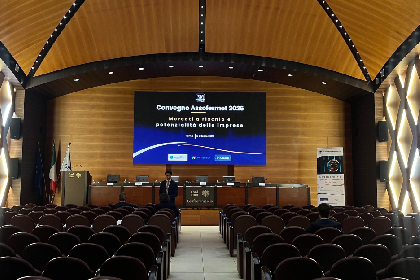
Tariffs, geopolitical tensions, new trade barriers, high energy costs and the reshaping of supply chains are redefining the environment in which Italian steel and metals companies operate. These were the key issues addressed at the autumn conference of Assofermet, held on Friday, October 2, at the headquarters of Confcommercio in Rome, under the title “Markets at risk, and potential for companies.”
Opening the event, following a video message from Confcommercio president Carlo Sangalli, Assofermet president Cinzia Vezzosi noted that the title chosen by the association several months ago had proved, in light of recent international developments, “almost uncomfortably topical”. Alongside ongoing conflicts and geopolitical instability, companies are now facing new trade restrictions, tighter measures affecting steel imports and the transition of CBAM into its most economically significant phase. However, Vezzosi's message was not solely one of concern. She highlighted the ability to react quickly as one of the main strengths of Italian SMEs: the capacity to anticipate change, address difficulties and adapt their strategies “in months rather than years”.
Tariffs and geopolitics redraw the global trade map
The first roundtable, moderated by Sissi Bellomo, commodity and energy markets editor at Il Sole 24 Ore, brought together Natalino Loffredo, ministerial adviser for International Trade Policy at Italy's Ministry of Foreign Affairs and International Cooperation (MAECI); Antonio Villafranca, vice president for research at ISPI; and Alessandro Panaro, head of the Maritime & Energy Department at SRM - Studi e Ricerche per il Mezzogiorno.
One of the main themes to emerge was the increasing use of economic tools as instruments of political pressure. According to Villafranca, the deterioration of the international order has been under way for at least 15 years, while trade, tariffs, raw materials and infrastructure are increasingly becoming part of a broader power dynamic. “Everything is becoming a weapon, including the economy,” he said, pointing in particular to the role of so-called chokepoints, strategic passages through which goods, energy and hydrocarbons flow.
Tensions surrounding the Strait of Hormuz have shown how the concentration of trade flows through a limited number of strategic routes can affect global supply chains. According to Villafranca, alternative routes and infrastructure can reduce some of these vulnerabilities, but inevitably at a higher cost.
This point was echoed by Alessandro Panaro, who said companies now have to factor a new item into their costs: the cost of geopolitics. “Logistics is like water: costs may rise, but it will always find a way through,” he said. Longer routes, surcharges and port congestion have pushed transportation costs higher, while supply chain reliability has deteriorated. Panaro cited a 112 percent increase in freight rates and vessel schedule reliability of around 50 percent. Despite this, the Mediterranean has continued to show considerable resilience: in 2025, Italian ports handled around 510 million mt, 30 million mt more than in the previous year.
According to Panaro, the response lies primarily in greater logistics efficiency, digitalization and sustainability, which are becoming increasingly important competitive factors. He took a different view of the EU ETS as applied to shipping, arguing that it risks becoming a competitive disadvantage if confined to the European market alone.
On the trade front, Natalino Loffredo described the United States as a “difficult-to-replace” partner for Europe, despite the sharp tightening of US tariff policy. Italy and Germany have supported an approach aimed at avoiding further trade escalation, while Section 232 remains a key issue for the metals sector, covering steel, aluminum and copper as well as a broad range of semi-finished and downstream products.
At the same time, relations with China remain another major issue. Loffredo stressed the need to keep dialogue with Beijing open while also promoting greater diversification of sourcing. However, such a process comes at a cost and, in his view, should therefore be supported by appropriate incentives for companies.
China's presence, moreover, extends well beyond trade flows. Panaro noted that Beijing has invested around $20 billion in Mediterranean ports since 2013, including through long-term infrastructure concessions. At the same time, SRM has recorded a 13 percent increase in intra-Mediterranean routes, further evidence that supply chains are already undergoing a gradual reconfiguration.
CBAM, energy and margins put European competitiveness to the test
The second roundtable, entitled “Energy for companies amid the complexity of global challenges,” featured Marco Gay, CEO of ZEST SpA and president of the Turin Industrial Union; Andrea Di Sotto, partner at SO.DE.MI Srl and AluGlobalBro Srl; and Riccardo Gabrielli, sales & area manager of the heavy plate division at Gabrielli SpA.
Andrea Di Sotto highlighted the difficulties facing the aluminum semis sector as it reshapes its sourcing strategies amid reduced Russian supply, antidumping measures, logistics constraints and new European regulatory requirements. From an importer's perspective, he described CBAM as “a hidden tariff,” stressing the uncertainty surrounding its initial implementation. “This is year zero for CBAM: we are importing material without yet knowing with certainty what the final cost will be,” he said. This uncertainty is complicating purchasing strategies and margin management at a time when companies are already being forced to rethink established supply chains and absorb higher costs throughout the value chain.
Focusing more directly on the steel sector, Riccardo Gabrielli stressed that CBAM is not merely an administrative compliance issue, but one with direct financial and commercial implications. Uncertainty over the actual carbon cost makes it difficult to value material that has already been purchased: for several thousand metric tons of imported steel, different cost assumptions can result in discrepancies running into hundreds of thousands of euros.
Gabrielli also pointed to the growing spread of carbon pricing systems outside the European Union, citing China, the United Kingdom and South Korea among others. In Italy, the growing complexity of imports is compounded by the decline in domestic steel production capacity. The downsizing of the former Ilva has increased the country's dependence on foreign supply just as sourcing from international markets is becoming more expensive and less predictable.
The central issue, therefore, remains competitiveness. Marco Gay stressed that the energy cost gap has been a structural problem for Italian industry for several years, while high logistics costs, interest rates and increasingly squeezed margins are adding further pressure. In Gay's view, the EU ETS cannot be seen simply as an economic issue, but as a factor that directly affects European industry's ability to compete and continue investing.
Against this backdrop, innovation and artificial intelligence can offer new levers for efficiency. Gay argued that the key issue will not be whether AI replaces jobs, but rather whether companies and workers are able to integrate it effectively into their processes. Gabrielli agreed on the need to focus on internal optimization, particularly at a time when many of the main cost drivers are increasingly beyond companies' direct control.
The debate ultimately returned to its starting point: in a market environment in which geopolitics, trade, logistics and energy are increasingly intertwined, resilience and the ability to adapt quickly remain essential, but they are not enough if the competitiveness of Europe's industrial system is undermined.
Closing the event, Cinzia Vezzosi declared, “I firmly believe that, as we move forward through this complex process, companies have a real responsibility, with the hope and conviction that the decisions we make today can concretely help build the future.”