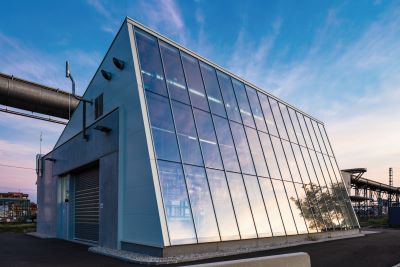
Austria-based steelmaker voestalpine and local energy company VERBUND have launched the expanded H2FUTURE green hydrogen pilot plant at voestalpine's Linz site, moving the research project into its next development stage. The expansion, costing €16.4 million, enables research into hydrogen compression, purification, storage, loading and further use in addition to green hydrogen production.
The H2FUTURE plant, which was commissioned in 2019 as the world's largest hydrogen pilot plant at the time, has been equipped with a compression and purification unit and five hydrogen storage tanks. Under the H2FUTURE-Follow-Up project, research will increasingly focus on preparing green hydrogen for industrial applications, particularly in terms of purity and pressure.
H2FUTURE to supply HY4SMELT from late 2027
Hydrogen produced through electrolysis will be compressed, purified and temporarily stored at the expanded facility. Four of the five new tanks will balance fluctuations between hydrogen production and consumption, while the fifth will be used for hydrogen delivery.
Starting from the end of 2027, the fifth tank will directly supply voestalpine's HY4SMELT industrial-scale demonstration plant in Linz through an approximately one-kilometer pipeline. HY4SMELT is described by the company as Austria's largest climate protection research project.
In addition, the hydrogen can be compressed to pressures of up to 500 bar and loaded into trailers for road transportation, allowing it to be supplied to external customers and other industrial and research projects. These include the SuSteel research project at voestalpine's Donawitz site.
First research results expected by end-2026
Functional testing under the H2FUTURE-Follow-Up project has already started, with the first research results expected by the end of 2026. The project is scheduled to run until December 2030 and is receiving funding from Austria's Federal Ministry of Economy, Energy and Tourism.
The existing H2FUTURE plant has a connected load of 6 MW and comprises 12 stacks, each containing 50 electrolysis cells. It can produce 1,200 cubic meters of green hydrogen per hour and has generated almost 2,000 mt of green hydrogen since entering operation in 2019.
Hydrogen to support voestalpine's steel decarbonization
The project forms part of voestalpine's research into the role of hydrogen in the transformation of its steel production. Under its greentec steel program, the company plans to commission one green electricity-powered electric arc furnace at each of its Linz and Donawitz sites in the first half of 2027.
Voestalpine expects this first transformation stage to reduce its carbon emissions by up to 30 percent by 2029, while its longer-term target is to achieve net-zero carbon emissions in steel production by 2050.