Czech steelmaker Třinecké Železárny is continuing preparations for its transition to low-carbon steelmaking while calling for stronger financial support from the Czech government and the European Union, Petr Popelář, chairman of the board of Moravia Steel, stated in an interview with Czech media outlet e15.
The company, which operates the Czech Republic's last integrated steelworks with a complete production cycle from pig iron to finished steel products, postponed plans last year to build an electric arc furnace (EAF) valued at approximately CZK 20 billion (€827.13 million). According to Popelář, the decision reflected broader challenges facing the European steel industry, including high electricity prices, uncertainty surrounding the EU Emissions Trading System (ETS) and the high cost of decarbonization.
“We were not the only ones to postpone such a project. Similar investments are being delayed across Europe,” Popelář said, adding that while the company fully supports decarbonization, current funding remains insufficient. He argued that a 50 percent subsidy would not be enough to ensure the long-term viability of the investment under current market conditions and said discussions with the Czech government and EU institutions are continuing to identify additional support mechanisms.
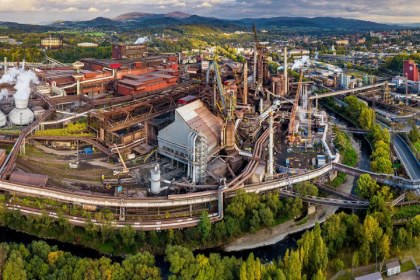
Infrastructure work continues despite delayed EAF investment
Despite postponing the EAF project, Třinecké Železárny continues to prepare for its future transition. A CZK 6 billion (€248.13 million) project is currently underway at Energetika Třinec to replace one boiler with a gas-fired power plant. At the same time, the company is developing infrastructure for the planned EAF, including land acquisition for a new high-voltage transmission line connecting the Guty site with the steelworks.
According to Popelář, the final investment decision will depend on whether the necessary economic conditions can be secured. He emphasized that adopting new steelmaking technology is essential to maintaining primary steel production over the long term. “If the current system remains unchanged, producing steel via the blast furnace route will no longer be economically viable,” he said.
ETS uncertainty and energy costs remain key concerns
Popelář identified the future of the EU ETS as one of the company's biggest concerns, particularly rising carbon allowance prices and the planned phase-out of free emission allowances, which management considers a major source of uncertainty for future investments.
He also commented on Moravia Steel's unsuccessful attempt to acquire assets from Liberty Ostrava. Although the company initially explored acquiring the entire business in early 2024, it later shifted its focus to the pipe rolling mill after the shutdown of Liberty's blast furnace, considering it a better strategic fit with Třinecké Železárny's operations. According to Popelář, restarting a blast furnace becomes increasingly difficult the longer it remains idle, describing its shutdown as the first major mistake in Liberty Ostrava's restructuring process.
War in Ukraine reshaped raw material supply and European steel market
The company also highlighted the continuing impact of the war in Ukraine. Following Russia's invasion in 2022, Třinecké Železárny lost control of its iron ore mine near Zaporizhzhia after Russian forces occupied the area. Although alternative raw material supplies were later secured, the company remains dependent on Ukraine for more than three million mt of iron ore annually.
According to Popelář, exceptionally strong steel demand immediately after the outbreak of the war made 2022 an unusually successful year. However, soaring energy prices subsequently weakened demand during 2023. He also noted that the destruction of Ukrainian steelmaking capacity in Mariupol fundamentally reshaped the European steel market, while Ukrainian producers continue to benefit from lower regulatory costs than EU steelmakers. According to Popelář, high European energy prices and carbon costs remain the two biggest competitive disadvantages facing EU steel producers compared with rivals in countries such as the US and China.
Looking ahead, Popelář stressed that steel remains strategically essential for Europe's security, infrastructure and industrial resilience. He noted that Třinecké Železárny is the Czech Republic's only rail producer and continues to supply rails to Ukraine, underlining the industry's importance in supporting infrastructure reconstruction during wartime.