One year after the US doubled Section 232 tariffs on steel and aluminum imports to 50 percent, the measures have significantly influenced domestic steel markets and global trade patterns, according to a recent report by S&P Global.
The tariffs, introduced by President Donald Trump in June 2025, were designed to strengthen domestic metals production, reduce reliance on imports and encourage new industrial investment. While the measures have contributed to higher steel prices and supported several investment announcements, analysts argue that their overall impact on manufacturing investment has been more limited than initially expected.
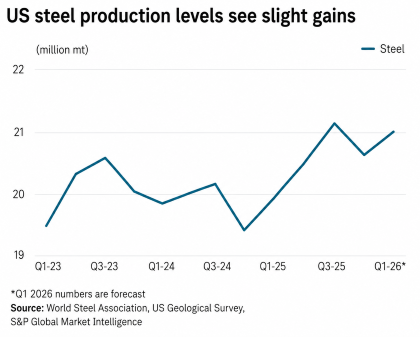
Domestic steel prices rise following tariff increase
One of the most visible effects of the higher tariffs has been the increase in US steel prices.
According to S&P Global, the Platts TSI Hot Rolled Coil Index for Indiana rose by nearly 35 percent year on year between early 2025 and early 2026. The higher import duties reduced competitive pressure from foreign suppliers and strengthened pricing power for domestic producers. The tariffs have also contributed to shifts in global trade flows as exporters seek alternative markets outside the US.
Investment projects emerge but remain selective
The White House has highlighted several industrial projects as evidence that its trade and manufacturing strategy is attracting investment into the US metals sector. According to White House spokesperson Kush Desai, a combination of tariffs, deregulation measures, tax incentives and energy policies has helped generate billions of dollars in new steel and aluminum investments.
In the steel sector, Cleveland-Cliffs signed a memorandum of understanding with South Korea's POSCO in October 2025 aimed at expanding POSCO’s customer presence in the US market. Subsequently, POSCO acquired a 20 percent stake in Hyundai Steel's planned $5.8 billion electric arc furnace project in Louisiana, supporting the expansion of domestic steelmaking capacity.
Analysts say tariffs alone do not drive investment decisions
Despite these developments, industry experts caution that tariffs represent only one element in the investment equation. Large-scale industrial projects typically depend on multiple factors, including government incentives, long-term demand visibility, access to markets and regulatory certainty.
Analysts noted that some recent projects have benefited from broader policy support beyond tariff protection. According to market observers, such complementary measures often play a more decisive role in final investment decisions than tariffs alone.
Manufacturing reshoring remains limited
A key objective of the tariff policy was to encourage the reshoring of manufacturing activity to the US. However, S&P Global noted that this goal has yet to fully materialize. Despite increased trade protection, the US manufacturing sector reportedly lost approximately 70,000 jobs during 2025. The figures highlight the challenges of rebuilding industrial supply chains and manufacturing capacity in an economy that remains deeply integrated into global production networks.
Industry participants argued that reshoring large segments of manufacturing requires not only trade protection but also competitive energy costs, workforce availability, infrastructure investment and long-term policy consistency.
Trade policy uncertainty remains a major obstacle
According to analysts and industry participants, the greatest barrier to additional investment may be uncertainty surrounding future trade policy.
Ongoing discussions over the renewal of the United States-Mexico-Canada Agreement (USMCA), evolving tariff structures, changing exemption mechanisms and the possibility of retaliatory trade measures have complicated long-term business planning. Investors also remain cautious because trade measures can be modified, reduced or eliminated by future administrations. For projects requiring billions of dollars in capital expenditure and development timelines stretching over many years, policy predictability is often viewed as essential. The interaction between Section 232 tariffs and other trade measures has further complicated assessments of future costs, market access conditions and supply chain strategies.
Steel industry calls for stable policy framework
US steel industry leaders continue to support the tariff measures but emphasize that policy stability will determine whether additional investment materializes.
Cleveland-Cliffs CEO and American Iron and Steel Institute (AISI) Chairman Lourenco Goncalves stated that manufacturers require predictable conditions before committing to major capital projects. Without certainty regarding future policy, planned investments may be delayed or cancelled.
AISI President and CEO Kevin Dempsey similarly noted that steel plant construction requires long development periods. While he believes the current tariff environment has improved confidence in the US market, he indicated that further investments will depend on maintaining existing protections and achieving sustained growth in steel demand.