Japanese steelmaker Nippon Steel Corporation has announced that it has successfully produced more than 1,000 mt of direct reduced iron (DRI) using 100 percent hydrogen as the reducing agent and low-grade iron ore as the raw material at its pilot-scale shaft furnace at the Hasaki Research & Development Center.
According to the company, the tests involved more than 300 hours of continuous operation using blast furnace-grade iron ore pellets, which have a lower iron content than the high-grade pellets typically used in conventional direct reduction processes. The pilot facility, which began operations in March 2026, has a furnace height of approximately 60 meters and a production capacity of 1 mt per hour.
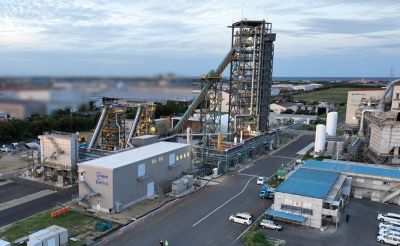
Nippon Steel addresses technical challenges in hydrogen-based DRI production
Nippon Steel stated that the successful operation was achieved by overcoming two major technical challenges associated with hydrogen-based direct reduction: the endothermic nature of hydrogen reduction reactions and the tendency of low-grade iron ore to generate fines during the reduction process.
Unlike natural gas-based reduction, which is currently used to produce approximately 100 million mt of DRI annually worldwide, reduction using 100 percent hydrogen absorbs heat, making it difficult to maintain stable temperatures inside the furnace. Meanwhile, the use of lower-grade iron ore presents additional challenges because the generation of fines can reduce gas permeability and affect reaction control.
To address these issues, Nippon Steel applied thermal compensation technology to maintain the required furnace temperature, together with operating techniques designed to suppress the powdering of low-grade iron ore. According to the company, these measures enabled stable DRI production during the continuous operation tests.
Company targets hydrogen-based DRI technology implementation by around 2040
The development forms part of Nippon Steel's Carbon Neutral Vision 2050, under which the company is advancing three technologies: high-grade steel production in large-scale electric arc furnaces, hydrogen reduction in blast furnaces and hydrogen-based DRI production.
Nippon Steel plans to continue testing at the Hasaki pilot facility to further develop its direct reduction technology and optimize operating conditions. From fiscal year 2027, the company intends to advance development activities, including scale-up technologies, with the aim of establishing implementation technology by around 2040.
The project is supported by Japan's New Energy and Industrial Technology Development Organization through its Green Innovation Fund. The hydrogen-based direct reduction initiative is being carried out by a consortium comprising Nippon Steel, JFE Steel Corporation and the Japan Research and Development Center for Metals.