Japanese steelmaker Nippon Steel has announced that it has commenced construction to convert blast furnace-based production to an electric arc furnace (EAF) process at its Kyushu Works (Yawata area), marking a major step in its decarbonization strategy.
The project aims to establish what the company describes as the world’s first integrated mass production system for high-grade steel using a large-scale EAF.
The initiative forms part of Nippon Steel’s “Carbon Neutral Vision 2050,” which focuses on three core technological pathways: high-grade steel production via large EAFs, hydrogen-based iron reduction, and hydrogen injection into blast furnaces. The company plans to implement these technologies across multiple production sites.
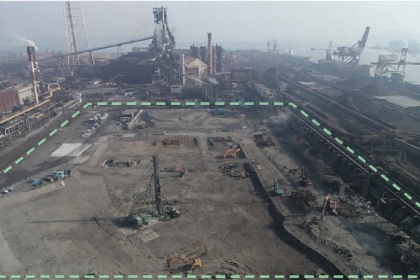
Large-scale EAF at Yawata
At the Kyushu Works (Yawata area), Nippon Steel will install a large-scale EAF with an annual crude steel production capacity of approximately 2 million mt. The project also includes secondary refining and continuous casting facilities.
Construction has already begun, with operations scheduled to start in the second half of fiscal year 2029. The total investment amounts to JPY 630.2 billion ($3.96 billion).
Expansion across multiple sites
At Setouchi Works (Hirohata area), the company plans to install an EAF with a production capacity of around 500,000 mt per year, supported by secondary refining equipment. The investment is estimated at JPY 140 billion ($879.82 million), with operations expected to begin in the second half of fiscal year 2029.
At Yamaguchi Works (Shunan area), a new EAF with a capacity of approximately 400,000 mt per year will be installed, with an investment of JPY 98.5 billion ($619.02 million). This facility is scheduled to come online in the second half of fiscal year 2028.