Ukrainian mining and steel producing group Metinvest is facing increasing operational and financial pressure in 2026 amid the blockade of Ukrainian ports, attacks on its steelmaking facilities, higher logistics and electricity costs and restrictions on steel exports to the EU, according to the company's chief operating officer Oleksandr Myronenko.
Myronenko stated that Metinvest's production costs have increased by approximately 30 percent year on year, mainly due to higher logistics and electricity costs. Against this backdrop, the company has suspended some investment projects and is considering significant cost and staff reductions, primarily involving administrative personnel and contractors.
Mining facilities operate at reduced capacity
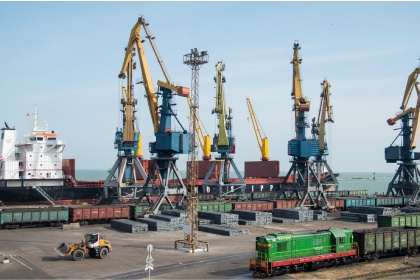
Currently, Metinvest's Central and Northern mining and processing plants are operating at around 50 percent capacity, producing pellets and high-quality iron ore concentrate for the EU market. Its Southern mining and processing plant is idle due to the closure of Ukrainian ports, while its Ingulets mining and processing plant has remained idled since 2024 due to high electricity costs.
According to Myronenko, iron ore concentrate prices would need to reach at least $135-150/mt to make the restart of the Ingulets facility economically viable. Meanwhile, Kametstal and Zaporizhstal are undergoing cleanup and restoration following attacks in August and September. Myronenko stated that the production chain at Zaporizhstal has been disrupted and that a full restoration of the damaged assets would cost tens of millions of dollars. Metinvest has declared force majeure on some contracts and is negotiating postponements or cancellations with its counterparties.
Port blockade increases pressure on exports and coal imports
According to Myronenko, the blockade of Ukrainian ports represents the company's main operational challenge. Before the blockade, the Southern mining and processing plant exported up to one million mt of iron ore per month, while the Northern and Central plants exported a combined approximately 500,000 mt per month through Ukrainian ports.
The port disruption has also affected Metinvest's coal imports. Following the shutdown of its assets in Pokrovsk, the company has needed to import around 250,000 mt of coal per month. While some volumes are transported by rail from the Czech Republic and Poland, alternative routes through Polish ports and Constanta have increased coal logistics costs by 50-60 percent, leaving margins close to zero.
With sea routes unavailable and other export destinations becoming uneconomic due to higher logistics costs, Myronenko said the EU is currently Metinvest's only viable major export market, although the company occasionally ships pig iron to the US through Poland when market conditions permit.
EU steel quotas limit export opportunities
At the same time, EU trade restrictions are limiting Metinvest's export opportunities. According to Myronenko, the quotas introduced in April allow the company to export around one million mt of products, approximately half of its previous-year volume. The restrictions apply to higher-value finished products such as coils, rebar and wire rod, while semi-finished products such as billets are not subject to the quotas.
The company is seeking changes to EU steel quotas, aiming to restore them to 2024 or 2025 import volumes. Myronenko stated that the restrictions have already undermined the business model of Metinvest's Romanian plant in Iași, which was acquired for €10 million and was intended to process material supplied by Zaporizhstal. The facility, which employs around 250 people in addition to a similar number of contractors, could potentially be idled.
Transitional period under EU CBAM sought
Metinvest also expects the EU's Carbon Border Adjustment Mechanism (CBAM) to create an additional financial burden. Myronenko estimated the potential impact at €50-100/mt of rolled steel, compared with a market value of around $600/mt. Although CBAM costs are formally borne by importers, he stated that customers may seek lower purchase prices or require Metinvest to assume import-related risks.
Metinvest is therefore seeking a transitional period for Ukrainian steelmakers under CBAM. Myronenko said the company would like CBAM-related costs to be postponed for at least two to three years after the end of the war, while a ten-year transition period would be preferable given the scale and duration of investments required to decarbonize steel production. Against the current challenging conditions, Metinvest has put further expansion and acquisitions in Europe on hold. Myronenko said the company's immediate priority is to reduce costs, maintain operations and overcome the current crisis.