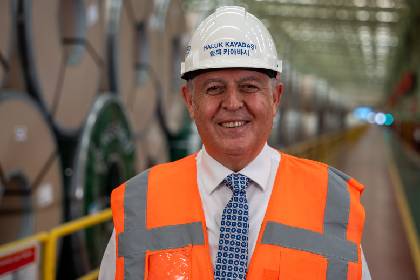
Commenting on Turkey’s 3.95 percent antidumping duty imposed on cold rolled stainless steel imports from China, Haluk Kayabaşı, CEO of Kibar Holding, stated that the decision will help prevent unfair competition in imports, pave the way for a level playing field in the steel sector, and reduce Turkey’s external dependence.
“Stainless steel is a strategic input for many industries”
As reported by SteelOrbis on Saturday, Turkey has decided to impose a 3.95 percent antidumping duty on stainless steel imports from China. According to Kayabaşı, the regulation represents the first phase of measures aimed at limiting the losses experienced by the sector, and further steps are expected to follow.
Kayabaşı noted that stainless steel is an indispensable input for many high value-added industries, ranging from automotive and healthcare to food, energy, and the defense industry. He emphasized that products at dumped prices originating from Asia and the Far East not only disrupt price balances in the domestic market but also significantly weaken the investment capacity of local producers.
Stating that protective trade policies implemented in many countries around the world provide a critical safeguard for domestic industry, Kayabaşı said he believes the antidumping measures introduced by the ministry will contribute to Turkey achieving sustainable growth in stainless steel production. Stressing that increased dependence on imports for such a strategic product would represent a major loss for the national economy, Kayabaşı added that antidumping measures will open the door to new investments.
Production, employment, and capacity growth expected in the new period
Highlighting that a new chapter is opening for Turkey’s stainless steel sector, Kayabaşı recalled that current local production meets only about one-third of the industry’s growing demand. He stated that Turkey’s annual cold rolled stainless steel consumption stands at around 400,000-450,000 mt, while imports account for approximately 80 percent of total consumption. Together with another local producer, they have the capacity to meet up to 90 percent of domestic market demand, he underlined.
“Following the publication of the antidumping decision by our ministry, I believe our production will increase significantly. Our capacity utilization rates will rise, our plants will produce at lower costs, and most importantly, employment and workforce levels will increase,” Kayabaşı said. He added that as investment appetite revives, Turkey’s competitiveness will strengthen, while a robust industrial ecosystem will help make value-added production permanent. He concluded that this step will reinforce Turkey’s position not only as a consumer market but also as a regional production hub.