The European steel industry has called on EU institutions to preserve the integrity of the EU Emissions Trading System (ETS) and strengthen the Carbon Border Adjustment Mechanism (CBAM), warning that current investment decisions will determine whether steel production, jobs and industrial value creation remain in Europe.
In a joint statement, Outokumpu, SSAB, Salzgitter AG, Saarstahl, Dillinger and Stahl-Holding-Saar said they are collectively investing more than €10 billion in low-emission steel production and modernized assets, but stressed that continued investment requires a predictable and credible policy framework.
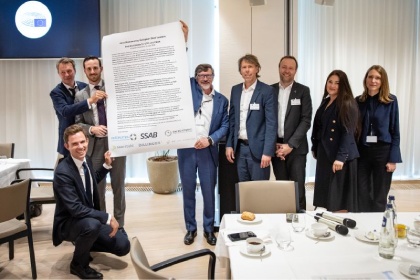
Companies call for maintaining key ETS mechanisms
The companies described the ETS as the cornerstone of the EU’s climate policy and said its carbon price signal must be maintained.
They called for retaining the Linear Reduction Factor (LRF) at 4.4 percent until at least 2035, aligning the post-2035 trajectory with the EU’s 2040 Climate Law, maintaining the existing CBAM factor and free allocation phase-out schedule, and preventing the use of the Market Stability Reserve (MSR) to artificially increase the supply of emissions allowances.
According to the statement, weakening the ETS would undermine investment certainty, penalize early movers and delay industrial decarbonization.
Steelmakers seek stronger CBAM and ETS revenue reinvestment
The companies argued that the main challenges to competitiveness are high electricity costs driven by fossil fuel dependence, infrastructure shortcomings and global steel overcapacity rather than carbon pricing. The steelmakers also emphasized that effective carbon leakage protection is essential. They said the CBAM should be strengthened by extending its scope to steel-intensive downstream products, preventing circumvention, and introducing a permanent solution for exports. They added that ETS revenues should be reinvested in industrial decarbonization, particularly in sectors covered by the CBAM.
Lastly, they urged EU institutions to safeguard the ETS, avoid measures that would weaken the carbon price, and accelerate the strengthening of the CBAM, stating that a competitive, low-emission European steel industry is essential for Europe’s sovereignty, security and resilience.