Brazil’s Ministry of Finance has announced a preliminary proposal defining sectoral coverage for the Brazilian Emissions Trading System (SBCE). The proposal was presented by the Extraordinary Secretariat of the Carbon Market (SEMC) to the Permanent Technical Advisory Committee (CTCP).
Steel sector included in first implementation phase
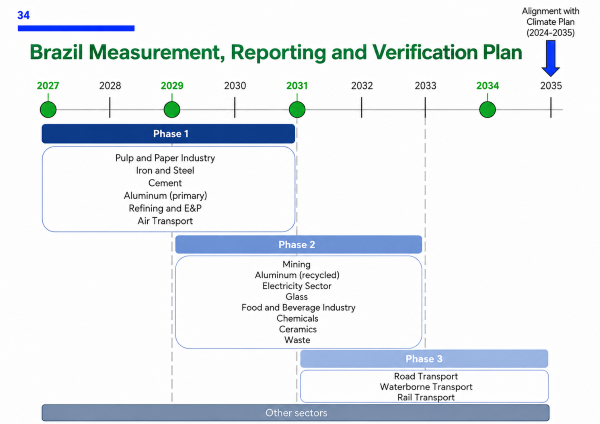
Under the proposed framework, the first phase will begin in 2027 and will include sectors such as iron and steel, paper and pulp, cement, primary aluminum, oil and gas exploration and production, refining, and aviation.
The second phase, scheduled for 2029, will expand coverage to sectors including mining, recycled aluminum, electricity generation, glass, food and beverage, chemicals, ceramics, and waste management. The third phase, beginning in 2031, will extend the system to road, rail, and waterway transport sectors.
According to the ministry, the phased structure is intended to gradually introduce monitoring, reporting and verification (MRV) obligations for greenhouse gas emissions across the Brazilian economy.
Initial period will not include carbon costs
The implementation model foresees a four-year transition period for each sector. The first year will focus on preparation of monitoring plans, the second and third years on emissions monitoring activities, and the fourth year on development of the National Allocation Plan. During this initial stage, companies will only be required to report emissions. No carbon costs, emissions reduction obligations, or financial penalties will apply at this point.
Large emitters targeted under legislation
The ministry also highlighted that Law No. 15,042 of 2024, which formally established the SBCE, provides for free allocation of emissions allowances under the first National Allocation Plan. Under Brazilian legislation, companies emitting more than 10,000 mt of CO2 equivalent annually will eventually be required to report emissions, while companies exceeding 25,000 mt may become subject to emissions caps and compliance obligations. According to the government, these thresholds apply to less than 0.1 percent of Brazilian companies and are intended to focus regulation on major emitters.
Government aims for predictable transition
Cristina Reis, extraordinary secretary for the carbon market at the Ministry of Finance, stated that the proposal aims to ensure a “gradual, predictable and evidence-based transition” while supporting both industrial competitiveness and decarbonization. The ministry also noted that 75 percent of future revenues generated through the regulated carbon market will be reinvested to support industrial transition projects and technological adaptation.
SEMC is expected to collect comments from CTCP members before launching a public consultation process in July, while the final regulatory framework is planned to be published in 2026.