This week, the major development in the Turkish flats market was the significant price reduction announced by Erdemir. In the previous week's analysis, we published a graph showing the correlation between the prices of Erdemir production 2 mm HRC and the worldwide crude oil prices, and also we said that Erdemir would apply a similar price correction in parallel to that seen in crude oil prices. The price decrease of $460$/mt announced this week has supported our projection - offering further proof of the relationship between commodity prices and oil prices.
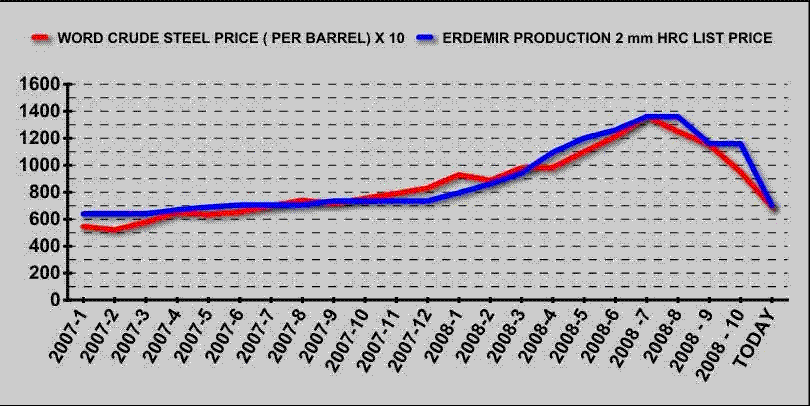
In Turkey, the prices of ex-Bulgaria, ex-Ukraine and ex-Russia materials; with 2-12 mm HRC at the range of $700-750/mt, CRC at levels of $800-850/mt, plates with thicknesses of 16-200 mm at $950-1,100/mt, and also the prices of other imported flat products, stood at high levels after the abovementioned price reduction seen in the Turkish domestic market. Meanwhile, it will be possible to see new price decreases of a minimum of around $100/mt in the coming days.
Taking into consideration that spot prices of iron ore, as well as prices of scrap, billet and slab, are moving towards bottom levels nowadays, it would not be wrong to think that flats prices are also approaching bottom levels. The effects of the production cuts implemented by the iron and steel mills is expected to be felt within one or two months, and business activities are expected to show a revival with the start of the new year. Against the background of these expectations, it may be said that the decrease rates of prices are about to slow down and come to a standstill. However, it will take some time to sell off the inventories after this point. Nevertheless, it will not be a surprise if the industry shows a faster revival than expected, once confidence is restored in the financial markets.
While some firms are in financial difficulties due to the recent downturn, it is forecast that the more powerful firms which have their accounts in good shape will remain standing throughout the crisis period and will grow stronger when the storm blows over. The banking sector should assume some responsibility as well as the real sector, in order to overcome the sluggishness seen in the domestic market. Radical measures taken by the banks such as; withdrawing agreed credit or refusing to issue new credit to firms, even to the major ones, will cause far greater damage to both the Turkish industry in general and the banks themselves. Looking at the global trading cycle, all of the developing economies are slowing down and registering increased slackness. The countries which manage to quickly overcome this situation will be able to seize the advantage within the new order that will be established. For this reason, each step to be taken by the government as well as by the industrial and financial sectors is crucial. This crisis reminds the Turkish industry and economy once more of the truth that we should further strengthen the production-based economy as opposed to relying heavily on outside financial sources.
The most important example which confirms of our suggestion for a production-based approach is to be found in the crisis which hit Asia in 1997. The 1997 crisis - very similar to the crisis seen today - started from Japan and spread out around Asia, cause many countries to suffer significant losses. The vital common trait of the countries which got through the period by learning their lesson and getting stronger, i.e. countries such as China, India and South Korea, is that they gave importance to their industries and production, establishing financial systems, and, most importantly, acting in unison. Turkish firms, in the struggle to survive in the consolidated world order, should act in unison without focusing too much on company sizes. Turkish industry can adopt similar cooperative measures, in a period which even sees countries joining their forces, and also with major firms like BMW and Mercedes or giant banks such as Bank of America and Merrill Lynch merging in order to overcome the crisis. For SMEs, it is time to switch to the structures of the strong companies which have their financial accounts in order. The iron and steel industry which is the leading sector in Turkey, has the strength and experience to overcome this crisis and to keep its losses down to minimum levels.