UK-based research center Materials Processing Institute has announced a £2.9 million upgrade of its seven-ton electric arc furnace (EAF), an investment designed to accelerate development of next-generation low-carbon steelmaking technologies.
The enhanced EAF will support industrial-scale testing, validation and advanced process development, enabling the institute to play a larger role in the UK’s transition toward cleaner steel production.
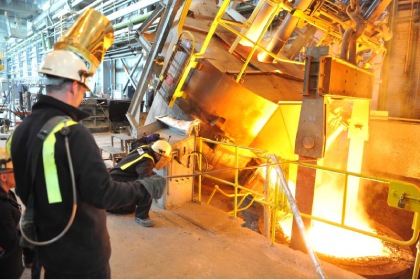
Advanced features to improve performance
New furnace components, including the furnace body, electrode systems, control panels, charging mechanisms, and hopper equipment, will begin arriving in December 2025. Initial dismantling work will commence before Christmas, including the removal of refractory linings, the extraction hood, and the existing roof.
The current EAF will be removed in January 2026, followed by installation, cold and hot commissioning, and final performance testing. The upgraded furnace is expected to reach full operational status by February 2026.
The institute will introduce a comprehensive set of upgrades to improve process stability, precision and energy efficiency. Key enhancements include jet-box powder injection enabling continuous treatment during active melting, HBI/DRI feeding systems featuring an argon-fed porous plug for more stable and uniform charging, fully automated temperature monitoring for real-time control, a carbon-injection stand for more accurate carbon control during heat cycles, expanded digital modelling functions to simulate furnace behavior and optimize process parameters, improved tapping and slag-removal systems, supported by enhanced hydraulic tilting accuracy, and electrode magnetic drives designed to deliver faster, more efficient melting cycles.
Supporting low-carbon steel development and specialized industrial applications
Once fully operational, the upgraded EAF will play a central role in developing new low-carbon and advanced steel grades. The institute expects the facility to help accelerate the UK steel sector’s shift toward EAF-based production, supporting industrial decarbonization objectives.
In addition to research applications, the furnace will enhance the Institute’s ability to produce specialist melts for sectors such as nuclear, defense, offshore engineering, aerospace and advanced manufacturing. These industries require tailored alloy compositions and controlled tonnage production, capabilities the upgraded EAF will be equipped to deliver.