Germany-based business consultancy CO2 IQ has indicated that the Carbon Border Adjustment Mechanism (CBAM) certificate price for the second quarter of 2026 is expected to remain broadly unchanged compared with the first quarter.
Under the CBAM framework, certificate prices for 2026 are calculated on a quarterly basis using prices recorded in primary auctions of EU Emission Allowances (EUAs), as SteelOrbis reported previously.
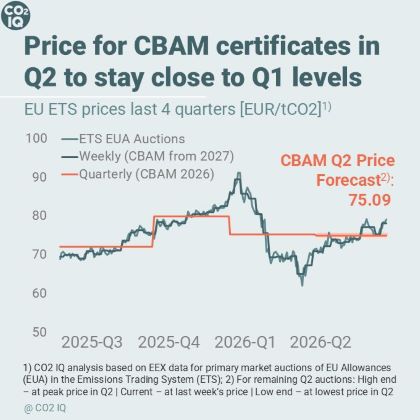
Although EUA market prices fell from above €90/mt CO₂e to approximately €60/mt CO₂e during the first quarter, auction prices remained relatively stable throughout the second quarter.
Auction prices remain within a narrow range
According to CO2 IQ, EUA auction prices during the second quarter have generally fluctuated between €70/mt CO₂e and €80/mt CO₂e. The consultancy stated that the average auction price since April has reached €74.62/mt CO₂e.
With only a limited number of auctions remaining before the end of June, CO2 IQ expects the final quarterly average to remain within a narrow range around current levels. Based on prevailing market conditions, the consultancy estimates that the official second-quarter CBAM certificate price will be slightly above €75/mt CO₂e if auction prices remain close to last week’s average of €78.16/mt CO₂e.
Under a higher-price scenario, the quarterly average could reach €75.27/mt CO₂e if auction prices return to the quarter’s peak of €79.37/mt CO₂e. Conversely, if prices decline toward the quarter’s low of €70.60/mt CO₂e, the average would fall to €74.07/mt CO₂e.
European Commission to publish official price in July
The European Commission is scheduled to announce the official CBAM certificate price for the second quarter on July 6. CBAM certificates covering imports made during 2026 will become available for purchase beginning in February 2027. These certificates will be priced according to the quarterly average applicable to the period in which the imports occurred. For imports made from 2027 onward, certificate prices will no longer be based on quarterly averages. Instead, they will be linked to the prevailing weekly average at the time of purchase.
CO2 IQ also stated that proposed ETS revisions, expected to be presented by the European Commission in July, may contribute to increased volatility in the carbon market during the third quarter of 2026.