German energy company EWE and Salzgitter Flachstahl GmbH, a subsidiary of German steelmaker Salzgitter AG, have announced that they signed a long-term agreement covering the annual supply of 10,000 mt of green hydrogen, marking a significant step forward for both Germany’s hydrogen economy and the decarbonization of steel production.
The agreement represents the first major offtake contract for hydrogen produced at EWE’s 320 MW electrolysis facility in Emden, which is currently under construction. It is also Salzgitter AG’s first large-scale external hydrogen procurement agreement.
Hydrogen deliveries are scheduled to commence in 2030 via Germany’s hydrogen core network and will continue under an initial seven-year contract period.
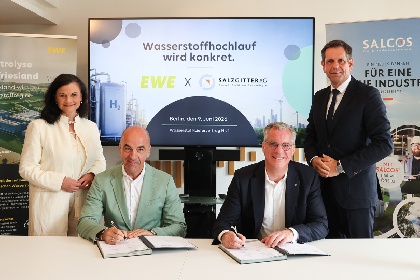
Hydrogen to support SALCOS® low-carbon steelmaking transition
The green hydrogen will play a key role in Salzgitter’s SALCOS® (Salzgitter Low CO₂ Steelmaking) program, which aims to replace conventional blast furnace steel production with lower-carbon direct reduction technology. According to the companies, the contracted volume will cover approximately 6.5 percent of the hydrogen demand required for the SALCOS® project.
The transformation strategy is designed to significantly reduce carbon emissions from steel production. Salzgitter’s direct reduction plant can already lower carbon emissions by around 60 percent when operating with natural gas instead of coal and coke. The company’s long-term objective is to transition fully to green hydrogen-based steelmaking, where water becomes the primary by-product instead of carbon dioxide.
Salzgitter estimates that its fully developed SALCOS® direct reduction facility will require up to 150,000 mt of hydrogen annually. To meet part of this demand, the company plans to produce approximately 9,000 mt of green hydrogen per year through a 100 MW electrolyzer currently planned for its steelworks. However, the majority of future hydrogen requirements will need to be sourced from external suppliers.
Regulatory framework remains a key challenge
Despite growing momentum behind hydrogen investments, both companies stressed that project economics remain heavily dependent on regulatory conditions. Particular concerns were raised regarding the European Union’s Renewable Fuels of Non-Biological Origin (RFNBO) certification framework, which governs the qualification of renewable hydrogen. The companies are therefore calling for greater regulatory flexibility to accelerate the development of Germany’s hydrogen economy and support industrial decarbonization investments.
The project benefits from significant public funding support at both federal and regional levels. The German federal government has allocated €925 million to support Salzgitter’s steel decarbonization efforts under the SALCOS® program. In addition, €267 million has been committed to support green hydrogen production at EWE’s electrolysis project in Emden.