According to the statement made by the chair of the OECD Steel Committee, Sheryl Groeneweg, after its 99th Session on March 23-24, 2026, in Paris, which brought together 288 government officials and industry representatives from 42 delegations, global steel markets are under renewed strain as excess capacity continues to expand, Chinese exports reach record levels and demand remains subdued, raising serious concerns regarding the long-term sustainability of the sector.
Global steel demand remains under pressure
The OECD Steel Committee stated that global steel demand has declined for four consecutive years, with the contraction exceeding two percent in 2025. Although a modest recovery is expected in 2026, the outlook remains uncertain, particularly due to geopolitical risks linked to the Middle East.
China’s steel demand is expected to continue its structural decline, albeit at a slower pace compared to the estimated 6.5 percent drop recorded in 2025. Meanwhile, the OECD region is projected to experience only a partial recovery, after a 1.5 percent decline last year. In contrast, emerging regions such as India, Southeast Asia and the MENA region continue to demonstrate relatively stronger growth potential.
Global excess capacity reaches record levels
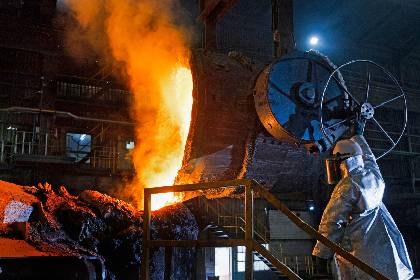
Global steel excess capacity increased to 640 million mt in 2025, exceeding total OECD steel production by more than 200 million mt, according to the OECD Steel Committee. At the same time, global steelmaking capacity rose for the fourth consecutive year, reaching 2.445 billion mt.
The divergence between regions has become more pronounced, with capacity contracting in OECD countries while expanding significantly in non-OECD economies. Growth has been particularly notable in India, Southeast Asia and the Middle East, especially Iran. The committee emphasized that continued over-investment is further exacerbating oversupply and intensifying global trade tensions.
China’s exports reshape global trade flows
The OECD Steel Committee reported that China’s steel exports reached 131 million mt in 2025, marking a record high and nearly doubling over the past three years. As domestic demand weakens, Chinese producers are increasingly redirecting surplus output to international markets. This trend has placed considerable pressure on producers in Europe, North America and Latin America, whose export volumes have declined in recent years as a result.
Trade measures rise but face circumvention challenges
Trade defense measures have continued to intensify globally, with governments increasingly relying on antidumping and countervailing duties, tariff-rate quotas and national security-based restrictions.
In 2025, a total of 75 new antidumping and countervailing duty investigations were initiated. However, the OECD Steel Committee noted that the effectiveness of these measures is being undermined by growing circumvention practices. These practices include the rerouting of steel through third countries, particularly in Southeast Asia, minor modifications to products to bypass tariffs, overseas investments aimed at changing the origin of steel, and the export of steel embedded in downstream products that are not subject to trade measures.
Subsidies continue to distort competition
The committee highlighted that market-distorting subsidies in the steel sector continue to increase, particularly outside the OECD region. According to the latest data, the median Chinese steel company received 15 times more subsidies relative to its asset size than firms elsewhere in 2024, compared to ten times in previous years. Additionally, China’s subsidy rate has nearly doubled since 2019, while 59 new provincial and municipal subsidy programs were introduced in 2025.
The committee also pointed out that capacity replacement programs aimed at reducing emissions are not resulting in net capacity reductions, as new low-emission capacity is being added without fully retiring existing facilities.
Energy security and geopolitical risks in focus
Amid ongoing geopolitical tensions, particularly in the Middle East, the OECD Steel Committee emphasized the growing importance of energy and raw material security. Ensuring affordable, stable and reliable energy supply has become a key priority for maintaining industrial competitiveness and safeguarding national economic security. These concerns are expected to remain central to policy discussions in the near term.
Call for stronger international coordination
The committee stressed that existing policy tools are insufficient to fully address the scale of the global steel crisis. In this context, delegates welcomed the ongoing efforts of the Global Forum on Steel Excess Capacity (GFSEC), which is working to develop a comprehensive framework for coordinated action by June 2026. This framework is expected to include enhanced monitoring of non-market practices, improved import surveillance mechanisms and stronger measures to combat trade circumvention.