Speaking at the Eurometal Steel Day & YISAD Flat Steel Conference, organized in collaboration with SteelOrbis at the Istanbul Marriott Hotel Asia on Tuesday, March 24, Hakan Aran, CEO of Turkish bank İş Bankası, stated that uncertainty in the global economy and geopolitical outlook has reached its highest level. However, he emphasized that current developments should not be viewed as coincidental, but rather as part of a broader transformation. Mr. Aran noted that the period of monetary expansion following the 2008 crisis did not actually resolve the underlying problems, and that, with the pandemic, disruptions in supply chains, demand imbalances and misguided capacity expansion decisions have created new global vulnerabilities. He added that in Turkey this process has extended into the past three years, characterized by high inflation, exchange rate increases, and subsequently tight monetary policies.
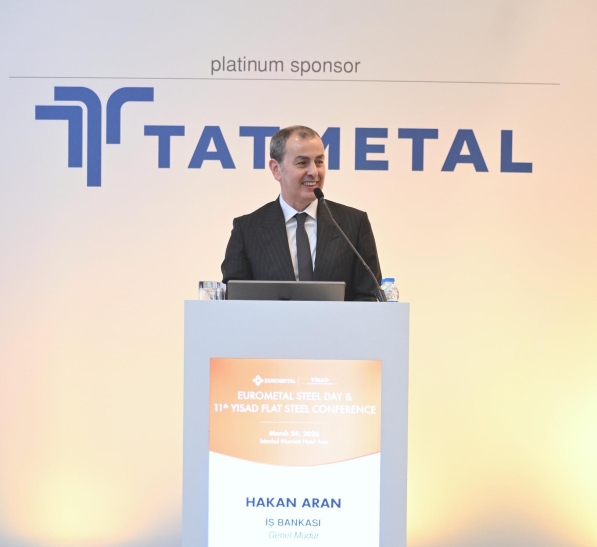
Mr. Aran stated that, from a political and geopolitical perspective, trade policies developed by the US against China, developments along the Russia-Iran-China axis, and the conflicts in Syria, Gaza and Ukraine in recent years should be analyzed together. He said that efforts are being made to shift China away from its position as the world’s sole production center, and that India and Turkey are expected to assume significant roles in this process. Aran pointed out that India’s decision to raise its steel production target for 2030 from 200 million mt to 300 million mt is a clear indication of this repositioning. He also stated that, in addition to the potential created by Syria’s reconstruction, Turkey could fill the void left by Iran, a key supplier of iron and steel to Gulf countries, due to the ongoing war.
According to Aran, pricing has been shaped by daily news flow related to the Iran war, but that the core issue is the supply shock linked to oil. He said that the contraction in supply corresponds to 20 million barrels of oil reserves, 40 percent of which is directed to China. Aran warned that, if the war extends beyond two months, it would mean a disaster for the global economy, and therefore there is hope that the crisis in the region will normalize before that point. He emphasized that these developments will also have consequences for the Turkish economy, stating that if the upward trend of energy prices becomes permanent, its current account deficit could reach at least $50 billion by year-end, the budget deficit could rise to four percent of GDP, and the Treasury may require approximately TRY 500 billion in additional borrowing. He also indicated that the growth rate for 2026 could fall below the previously expected four percent level.
The İş Bankası CEO added that it no longer appears possible for the Central Bank to intervene in this situation by raising interest rates, and that they believe 40 percent will be the highest interest rate level that could be seen during the year. According to Aran, the main risk is not inflation but rather cash flow, the inability to pass rising costs on to selling prices, and the slowdown in economic activity reducing demand. He emphasized that demand in the steel sector is highly sensitive to economic activity, warning that costs currently reflected in prices could remain on companies’ balance sheets if demand weakens sharply.
Providing evaluations regarding the steel sector, Aran stated that the EU will further restrict import quota volumes in the period after June, and that imports exceeding the quota will be subject to a 50 percent duty. He also noted that the US has increased steel tariffs to 50 percent as part of trade wars. He indicated that the global steel market contracted by three percent in 2024 and by two percent in 2025, while global crude steel production stands at 1.8 billion mt, and that a period where production and consumption will be balanced is expected to begin in 2026.
Sharing data on Turkey, Aran stated that the steel sector produced 40.4 million mt in 2021, while production remained at 38.1 million mt in 2025, up 3.3 percent year on year. He said that the producer index in the metal sector fell to 44.3 in February, the lowest level since April 2025, with production declining by 7.8 points and new orders by 2.9 points, while export orders also slowed. He noted that in 2025 Turkey recorded 18.9 million mt of imports against 15.1 million mt of exports in the steel trade, with export revenues at $10.2 billion and the import bill at $13.1 billion, bringing the export-to-import coverage ratio down to 77.6 percent. Aran also stated that during the same period Turkey imported 4.5 million mt of steel from Russia and 4.2 million mt from China.
Despite all the risks, Aran emphasized that the window of opportunity remains open for Turkey. He stated that, thanks to potential new demand in nearby regions, Turkey could increase its steel exports from 15.1 million mt to 20 million mt and export revenues from $10.2 billion to $17 billion. He added that Turkey’s production from scrap via electric arc furnaces and its progress in green transformation under the Carbon Border Adjustment Mechanism would provide a strategic advantage in trade with the European Union. However, he warned that companies should remain cautious against sudden drops in demand, deterioration in cash flow, and pressure on debt servicing capacity. Referring to assessments that the European Central Bank could revise its 2026 growth forecast from 1.2 percent to 0.9 percent, or even down to 0.4 percent if the war is prolonged, Aran highlighted that the Middle East and Gulf countries are gaining importance in response to the slowdown in the EU market. He concluded his remarks by expressing his belief that the sector can overcome this challenging period through solidarity.