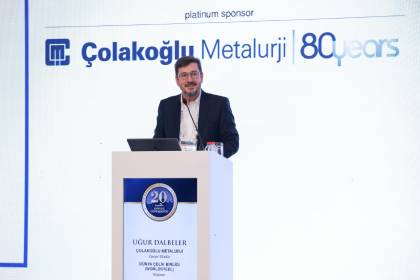
At the SteelOrbis “New Horizons in Steel Markets” 20th Annual Conference held on Tuesday, December 9 at the Istanbul Marriott Hotel Asia with more than 500 participants, following the opening speech by SteelOrbis general manager Murat Eryılmaz, Çolakoğlu Metalurji general manager and World Steel Association (worldsteel) chairman Uğur Dalbeler stated that the steel industry is experiencing one of the most unbalanced, turbulent and unfair periods in recent memory, that the biggest problem under current market conditions is global overcapacity, and that Turkey urgently needs to implement safeguard measures.
Free trade being replaced by protectionist policies
One of the main themes in Mr. Dalbeler’s speech was the shifting balance in global trade. He noted that countries long considered the champions of free trade have now turned toward protectionist policies, while actors who hide behind free-trade rhetoric continue to flood global markets with excessive capacities, distorting competition. Dalbeler emphasized that Turkey has abided by the rules of the European Coal and Steel Community since 1997, but today European policies have increasingly taken a more exclusionary stance towards Turkey.
Deepening crisis in energy costs
Energy prices were another major issue highlighted by the worldsteel chairman. He stated that the factor weakening Turkey’s competitive strength in steel production most significantly is the cost of energy: energy prices in the industrial sector have doubled since Russia’s invasion of Ukraine in 2022, and Turkey has become one of the most expensive countries in the world for producing steel using electricity. He added that the persistently high level of energy costs puts long-term pressure on the industry's cost structure and is not sustainable.
Labor costs and exchange rate are escalating expenses
Other structural issues Mr. Dalbeler touched upon included rising labor costs and the policy regarding the Turkish lira. He noted that labor costs in Turkey have increased rapidly in US dollar terms in recent years, and that, with new nationwide collective bargaining agreements coming into effect in January, these costs are likely to rise well above inflation again.
CBAM and EU quotas - a growing risk for Turkey
The EU’s Carbon Border Adjustment Mechanism (CBAM), which will enter into force on January 1, has created significant uncertainty for the industry. Dalbeler stated that the sector still lacks clear guidance from the European authorities and that this ambiguity poses a serious risk. Additionally, even if the European Union’s steel import quotas are reduced by 50 percent for 2026, Turkey’s steel exports to the EU could decline by 60-65 percent, he warned. Combined with the United States’ steel tariffs of up to 50 percent, Turkey, an exporter by necessity, faces increasingly shrinking markets.
Turkey’s imports have exceeded its exports for the first time
Dalbeler drew attention to the fact that Turkey is experiencing, for the first time, a period in which its steel imports have surpassed its exports. He noted that the main reason behind this is the unfair competition caused by dumped and subsidized products from China and other countries. Highlighting that Chinese-origin hot rolled coil entering Turkey at $470/mt is far from realistic considering actual production costs, he said such prices force Turkish producers into an unsustainable competitive environment. He warned, “Keeping the doors open may lead to consequences that will be extremely difficult to remedy,” emphasizing the urgent need for Turkey to introduce safeguard measures to protect its steel industry.
During the subsequent Q&A session, participants discussed issues such as protectionism, import pressure, costs and efficiency challenges, and the lack of a unified national strategy for Turkey’s steel sector. While some noted that the 25 percent domestic raw material procurement requirement for rebar creates supply shortages and price increases in certain regions - placing exporters at a disadvantage - others argued that the ratio should be raised to at least 50 percent, otherwise dumped Chinese products would damage both the domestic market and the long-term viability of Turkish producers. Responding to a question on cost and efficiency, Dalbeler stressed that the Turkish steel industry is in fact highly competitive and adaptable but is undermined by high energy and labor costs along with unfair competition created by subsidized and dumped imports. Participants also emphasized the importance of focusing not only on direct steel exports but also on indirect steel exports via white goods, automotive and machinery, noting that Turkey’s real goal should be exporting higher value-added industrial products. Additionally, the absence of a comprehensive national industrial and steel strategy, one that incorporates the sector’s internal dynamics and is embraced by all stakeholders, was highlighted as a major obstacle, creating fragmented decision-making and increasing uncertainty for both producers and exporters.