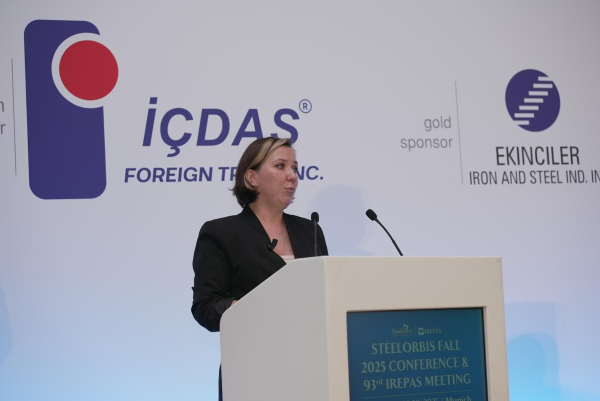
During her presentation on the outlook for the Indian and ASEAN steel markets during the second session of the SteelOrbis 2025 Fall 2025 Conference & 93rd IREPAS Meeting held in Munich on September 28-30, Anastasiia Kononenko, head of the Asia market intelligence team at SteelOrbis, focused on production growth, consumption, the impacts of tariffs and import-export dynamics.
India sees rising consumption and expanding capacities
Ms. Kononenko noted that both Indian finished steel production and consumption exceeded expectations in August this year, with 13.4 million mt of production and 13.5 million mt of consumption. The country’s finished steel consumption rose by 11.5 percent in FY 2024-25 (April 1, 2024 to March 31, 2025), while long-term forecasts suggest a six percent annual growth rate through 2030. This would add approximately 43 million mt of additional demand over five years. She added that growth has been very sustainable for the past five years, and so far all signs indicate it will continue.
Regarding the pace of crude steel production growth, which is faster than demand growth, Ms. Kononenko stated that in FY 2024-25 the speed of increasing crude steel capacities in India was the fastest in the last 10 years, mostly at existing plants. However, greenfield projects continue to face challenges, particularly in land acquisition. She remarked that, out of 95 million mt of planned new capacity over the next five years, only eight percent has been approved so far, raising doubts regarding full implementation. Despite its rapid increase, she emphasized that the production growth is justified and remains in line with consumption trends.
Despite the imposition of 50 percent US tariffs on steel imports, the direct impact on Indian mills remains limited, mainly affecting India’s pig iron exports to the US, which account for about 10 percent of India’s total steel exports. Stating that the impact of the US tariffs on the Indian steel market is manageable as India focuses on more profitable sales to its local market, the EU and the Middle East, the SteelOrbis official noted that the country will be one of the countries most impacted by the EU’s CBAM.
Regarding India’s exports, pointing out that the country’s semi-finished exports, particularly of slabs, rose significantly in the first half of 2025, more than doubling year on year, Kononenko noted that these shipments are opportunistic and not a structural trend. Meanwhile, indicating that India has become a net steel importer for the second year in a row, she said that in April 2025 the Indian government had introduced a 12 percent safeguard duty on flat steel products, recommended for three years, which is considered to be more effective than the previous measures, reducing the monthly import volume to 140,000 mt, down more than 2.5 times compared to the average last year. “These measures are working better this time, supporting the local market,” she explained.
Steel production in ASEAN region outpaces demand
Stating that steel demand in the ASEAN region rebounded in 2024 with growth just under five percent, Ms. Kononenko noted that, however, the consumption in the ASEAN countries remains below 2018-2019 levels. For 2025, demand is expected to grow by only 2-3 percent, mainly supported by private construction and large-scale infrastructure.
Noting that steel production in the region continues to rise, outpacing demand, she stated that capacity expansions continue across the region. In particular, Vietnam-based Hoa Phat has doubled its capacity to 12 million mt this year, while Indonesia-based Dexin Steel is expanding its capacity to 10 million mt.
Similar to India, the impact of the US tariffs is also manageable in ASEAN countries, while Indonesia will join India as one of the countries to be impacted the most by CBAM.
Looking at the import-export outlook for ASEAN countries, the region’s imports are foreseen to be stable in the near future, but to decline gradually in the longer term amid higher domestic steel production, while the ASEAN region’s steel exports still have the potential to increase with more mills being planned with Chinese investments.