According to the statistics provided by the Turkish Statistical Institute (TUIK), Turkey's ferrous scrap imports in the January-August period this year decreased by 17.05 percent year on year to 12.5 million metric tons. Speaking at the SteelOrbis Fall 2013 Conference & 69th IREPAS Meeting held in Istanbul on September 22-24, Dr. Veysel Yayan, general secretary of the Turkish Iron and Steel Producers' Association (TCUD), said that the main reason behind the drop in Turkey's scrap imports has been the decline in the country's crude steel production, which showed a year-on-year drop of 5.4 percent in the abovementioned period. Dr. Yayan also emphasized that the increase of 6-7 percent in Turkey's domestic scrap supplies has also played a role in lower scrap imports. At the same time, it is also important to point out that Turkey's steel billet imports surged by 32.1 percent in the first eight months this year.
An ex-US HMS I/II 80:20 scrap deal has been heard today, October 1, at $365/mt CFR, while the transaction level for HMS I/II 80:20 scrap in Turkey has settled at $362-365/mt CFR. Turkish mills will likely continue to conclude new deals at these levels before the holiday. Meanwhile, price levels in ex-UK HMS I/II 80:20 scrap deals are at $355-360/mt CFR.
On the other hand, the latest ex-Romania A3 scrap deals have been concluded at levels of $353-354/mt CFR, while Russian scrap deals in Turkey have been concluded at $355-360/mt CFR. Scrap collection prices in Russia, meanwhile, are at $330/mt, while Turkish mills' demand for short sea scrap has remained on the low side lately.
The sideways or just slightly downward trend of scrap prices indicates that import scrap prices may be approaching to bottom levels. Demand in the local Turkish finished steel market, which has remained somewhat better than in the export markets, has prevented scrap prices from declining further, while import scrap prices will likely trend upward after the holiday as they traditionally do before the winter. This situation may help finished steel export offers to follow a sideways trend or register increases despite weak demand.
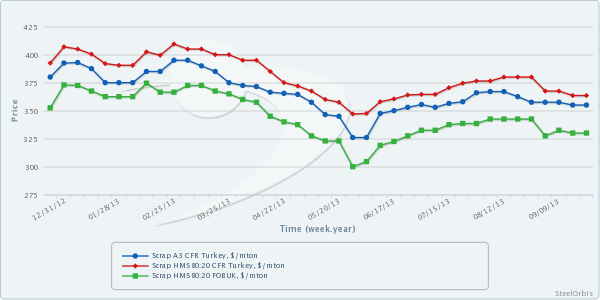
Weekly price movements of different steel products in major markets can be viewed comparatively in the SteelOrbis Historical Steel Prices section. Market trends can thus be seen more clearly, while desired charts can be created and used in reports or presentations.