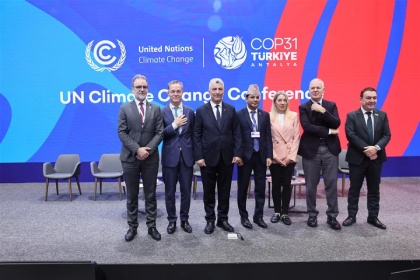
Turkish Minister of Trade Ömer Bolat has emphasized the importance of coordinating climate action, international trade and industrial development to support the green transition, speaking at the “Climate, Trade and Competitiveness: Coordination from Regulation to Implementation” panel held during COP31 in Antalya, Turkey.
Turkey aims to translate its climate commitments into concrete actions and measurable results, Bolat stated, highlighting the role of international trade in facilitating access to clean technologies, sustainable products and investment opportunities. He stressed that climate action, trade and industrial development should reinforce one another rather than be treated as competing priorities, particularly amid geopolitical uncertainty, supply chain disruptions and volatile energy markets.
Turkey's EU trade relations shape its green transition policies
The green transition has long been a key priority of Turkey's trade policy, particularly because of the country's close economic integration with the European Union and its more than 30-year Customs Union relationship, according to Bolat. Turkey adopted its Green Deal Action Plan in 2021 in response to the European Green Deal, which has significant implications for industrial production, investment and market access.
The minister also highlighted Turkey's ratification of the Paris Agreement in 2021 and the adoption of its Climate Law in July 2025, which established the legal framework for national carbon pricing and an emissions trading system (ETS).
Industrial decarbonization and sustainable finance support Turkey's 2053 net-zero target
Turkey has developed strategies and roadmaps covering industrial decarbonization, the circular economy, sustainable finance and clean energy to support its 2053 net-zero emissions target. The green transition also creates opportunities for new markets, products, services and investments, while cooperation between governments, international organizations, financial institutions and businesses remains essential, Bolat noted.
International cooperation should take into account countries' different development needs and ensure that financing and clean technologies reach developing economies and smaller producers, according to the minister. He also stressed the importance of translating climate objectives into practical measures through cooperation to support both economic development and the green transition. Bolat concluded by reaffirming Turkey's commitment, as COP31 President, to translating shared climate objectives into collective action.