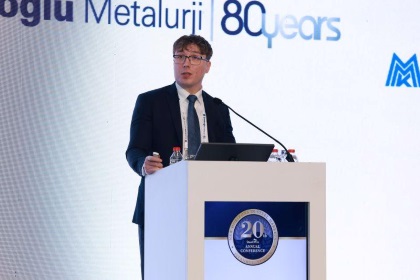
At the 20th SteelOrbis “New Horizons in Steel Markets” Conference held on Tuesday, December 9, in Istanbul Marriott Hotel Asia, Luciano Giua, economist and policy analyst at the Organisation for Economic Co-operation and Development (OECD), presented an overview of situation in the European steel market in 2025.
Global steel excess capacity
The first point Mr. Giua covered in his intervention was global steel excess capacity. In Europe, capacity is expanding at a rapid pace, but demand is not following. This will lead to a capacity of over 700 million mt by 2027, particularly in countries that are already experiencing overcapacity.
Another factor that drives excess capacity are subsidies, such as grants, below-market financing, tax breaks and subsidized energy, that keep unprofitable firms in the market. “China’s subsidisation rate is around ten times higher than in OECD countries,” he noted.
To address this critical issue, the Global Forum on Steel Excess Capacity (GFSEC), a multilateral platform established by the G20 in 2016 that brings together 28 major steel-producing economies, has identified three key areas where there is the need for coordinated action:
- Monitoring: deepen the work on non-market policies and practices to understand economies outside the GFSEC.
- Boosting effectiveness of trade actions: exchange experiences on matters like melt and pour, detection of circumvention, sharing data and methodologies to strengthen trade actions.
- Collective actions: developing a comprehensive framework by June 2026.
Mr. Giua stressed the importance of cooperation, stating, “The goal now is to move from diagnosing the problem to finding solutions that will support the global steel environment. No single economy can face overcapacity on its own.”
Demand in Europe expected to remain weak in 2025
The OECD official then proceeded by stating that European producers do not expect demand to recover in 2025. While in Asia manufacturing activity is continuing to expand, in Europe demand is still very weak across most of the key sectors (mechanical engineering, automotive, etc.) and the situation in the US is quite volatile.
Because of this decline, prices will most likely be low in the coming months. In early 2025, sentiments began to weaken, while getting worse by the second half of the year.
High energy costs contribute to decline in Europe’s steel production
According to OECD data, EU crude steel production declined by about 23 percent between 2011 and 2024, and by 3.4 percent year on year in the first ten months of 2025. EU steelmaking capacity fell by 16 percent between 2008 and 2024.
These figures do not only reflect sluggish demand, but also high energy costs, which are one of the main factors undermining the competitiveness of the European market. Meanwhile, in countries where these costs are much lower, and often subsidized, crude steelmaking capacity has increased by 70-75 percent since 2010. In particular, energy costs in the MENA region are ten times cheaper than in Europe.
Steel exports down, steel imports up
As far as exports are concerned, Mr. Giua warned that Europe faces a structural decline: exports have fallen by 18 percent between 2020 and 2025. On the contrary, Chinese exports have increased by 128 percent in the last five years.
On the other hand, it is important to note that Europe is becoming more and more reliant on imported steel, with a 22 percent increase in imports since 2020. Such a sharp increase has triggered a rise in trade actions. For example, in 2024 the European Union initiated four antidumping actions, against China, Japan, Egypt and Vietnam, while in 2025 it initiated five, against Japan, India, Turkey, Taiwan and Vietnam. Still, Mr. Giua stated that the European Commission should further tighten its safeguards.
To sum up, the European market is facing weak demand, falling prices and declining production. In this context, global overcapacity is out of control and is driving export surges, particularly from China and the ASEAN region. Commenting on the worsened trade position of Europe, Giua stated, “It cannot be explained by domestic factors: it is shaped by the global dynamics that are putting additional pressure on its market.”