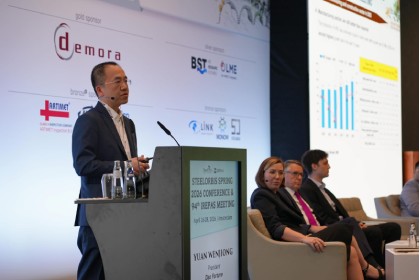
Speaking at the SteelOrbis Spring 2026 Conference & 94th IREPAS Meeting taking place in Amsterdam on April 26-28, Yuan Wenjiong, president of Dao Fortune, outlined the current trends in China’s steel market, highlighting weakening domestic demand, structural shifts in the economy and increasing pressure on exports.
Construction downturn continues to weigh on demand
Mr. Yuan stated that China’s apparent steel demand declined by 7.8 percent in 2025, mainly due to the continued downturn in the construction sector. While rebar demand remained under pressure, declining by around five percent last year, flat steel demand showed more resilience, with hot rolled coil (HRC) consumption posting modest growth of about one percent. He noted that this divergence reflects the ongoing shift in China’s economic structure, where manufacturing continues to outperform the real estate sector.
He emphasized that the slowdown in the real estate market remains the key factor weighing on steel demand, pointing to declining new construction starts and falling investment levels. Infrastructure investment, traditionally a major support for steel consumption, also turned negative for the first time, as funds were increasingly diverted toward debt restructuring and land repurchases by local governments. According to Mr. Yuan, this indicates that China’s infrastructure development has largely matured, while government policy is now increasingly focused on high-tech and manufacturing-driven growth rather than investment-led expansion.
Manufacturing supports flat steel demand amid structural shift
Despite the weakness in construction, China’s manufacturing sector has continued to perform better than expected, supporting flat steel demand. Mr. Yuan noted that HRC production rose by 7.6 percent in 2025, marking one of the highest growth rates in the past decade, as steelmakers shifted production away from long products toward flat products. However, he added that this shift is unlikely to fully offset the decline in construction-related demand.
Looking ahead, he stated that domestic steel consumption is expected to decline slightly in 2026, with total demand forecast to decrease by around 0.1 percent. Construction demand is projected to fall further by approximately 2.5 percent, while manufacturing demand may continue to grow, albeit with increasing uncertainty. He added that, although there are some early signs of stabilization in the real estate market, such as declining housing inventories and more stable prices, these improvements are not expected to significantly boost steel demand in the near term.
Exports under pressure amid rising protectionism
Turning to external markets, the Dao Fortune president noted that Chinese steel exports are likely to face increasing challenges amid rising trade protectionism. He stated that antidumping measures are expected to intensify in 2026, particularly in key markets such as Vietnam, South Korea and Brazil, which could reduce export volumes by 12-15 million mt. While semi-finished exports may increase to 20 million mt, up 5-7 million mt due to supply disruptions linked to geopolitical tensions, overall exports are still expected to decline by around 10 million mt.
He also highlighted the impact of tightening trade policies in Europe, noting that the EU’s revised quota system and higher out-of-quota tariffs are likely to limit Chinese exports to the region, despite a 35 percent increase in shipments to the EU in 2025 driven by weak domestic demand and competitive production costs.
Raw materials and energy outlook to shape global prices
Commenting on raw materials, Mr. Yuan stated that iron ore and coking coal markets remain highly sensitive to geopolitical developments. While iron ore supply is expected to remain sufficient in the long term, prices have stayed relatively strong due to supply disruptions and ongoing negotiations between major producers and Chinese buyers. In contrast, coking coal prices have shown more volatility, with short-term pressure followed by expectations of stronger prices later in the year, depending largely on the trajectory of global conflicts and energy markets.
Yuan also underlined that China’s relatively low dependence on crude oil provides a cost advantage during periods of geopolitical tension, as coal continues to account for over half of the country’s energy consumption. At the same time, the growing share of renewable energy sources such as solar and wind power could further strengthen this advantage if oil prices remain elevated.
Assessing the global outlook, he stated that the trajectory of energy prices will be a key determinant for steel markets. According to his scenarios, if Brent crude oil prices remain at around $100/mt for two months, global steel prices could increase by $30-35/mt, while a rise to $120/mt could push prices up by $40-45/mt, albeit with some demand erosion. In a more extreme scenario, where oil prices reach $130/mt and remain elevated for a prolonged period, a global recession could follow.
In general, Mr. Yuan concluded that, while there is no strong driver for a sustained upward trend in steel prices, international prices are likely to remain supported by high energy costs and the potential appreciation of the Chinese yuan, which could strengthen by 5-10 percent in the period ahead.