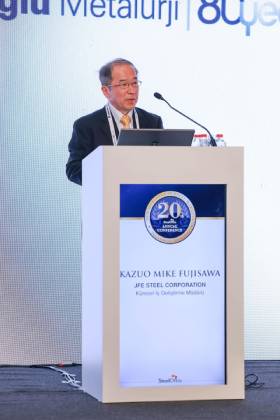
Speaking at the 20th SteelOrbis “New Horizons in Steel Markets” Conference held in Istanbul on Tuesday, December 9, Kazuo Mike Fujisawa, principal of global business development at Japan’s JFE Steel Corporation, offered an overview and outlook of the steel industry in East Asia.
Starting with worldsteel projections, Mr. Fujisawa stated that global steel demand reached bottom levels in 2025 and is expected to grow in 2026, because, despite the global trade disruptions, the global economy has shown great resilience. Moreover, a number of factors give reason to believe in a possible recovery of demand in 2026, among which are lower steel demand in China, the projected growth of economies such as India, Vietnam, Egypt and Saudi Arabia, and a possible return of a steel demand increase in Europe. However, challenges such as high production costs and trade tensions weighing on exports of steel-intensive goods could also be an obstacle to steel demand growth.
In the last five years, apparent finished steel usage has been slowing down in Asian countries such as China, Japan and South Korea, but has been growing in ASEAN-5 countries and India.
Weak outlook in China, Japan and South Korea; ASEAN-5 and India stand out
In China, the GDP growth rate has been decelerating since 2022, with industrial production growing at its weakest pace in over a year in October, and with falling real estate investments and investments in fixed assets. Exports also declined year on year in October, and, according to Mr. Fujisawa, steel usage in China will continue to decrease in 2025 and 2026 because of the weakness in the real estate segment and the shift from an investment-based economy to a consumption-based economy.
Moreover, crude steel production in China has decreased marginally since 2021, and the further
decline in domestic steel demand has increased export pressure. In the January-October period this year, Chinese crude steel production declined by 3.9 percent year on year, whereas steel exports increased by 17.3 percent year on year in the same period.
In Japan, the real GDP growth rate is forecast to grow moderately by 0.8 percent and 0.7 percent in 2025 and 2026, respectively, reflecting a largely flat industrial production index and auto production. As for the construction sector, housing and non-residential building constructions have been weak due to increased construction costs, an ongoing labor shortage, and a change in regulations for working hours and for the environmental performance of houses. Steel use is forecast to continue to decrease to 48 million mt in 2025 and 2026, mainly due to the weakness of the construction sector.
The South Korean economy has faced challenges such as a delayed recovery in construction investment, labor issues, and export slowdowns due to US tariffs. GDP in South Korea is expected to grow by 0.9 percent in 2025 - the lowest level after the pandemic - mainly due to weakness in construction investments. In 2026, economic growth is expected to rebound to 1.6 percent, as policy measures support a recovery in domestic demand. However, investment in construction is set to decline by 8.5 percent in 2025 and domestic auto production is foreseen to decrease by 2.0 percent in the same year. As a consequence, steel use has decreased this year and is expected to stagnate in 2026 as construction recovers moderately and manufacturing growth continues to slow due to the deteriorating export conditions.
JFE: Mature economy pressures and the search for new strategic partnerships
In the concluding part of his speech, Mr. Fujisawa explained that the slowdown of the Chinese economy has impacted many countries in Asia. In particular, Japan has entered the phase of a mature economy, as showed by demographic changes. “Also, steel usage is decreasing and manufacturing production has shifted overseas. That’s why we had to downsize our capacities”, he said, adding, “However, we don’t want to keep shrinking. That’s why we are looking for strategic partnerships, and we believe that the one we're developing in India, for example, might be a good opportunity”. In this regard, in December 2025 JFE Steel started a 50:50 joint venture with India’s JSW Steel to acquire Bhushan Power & Steel Limited (BPSL) and mines in India’s largest iron ore producing region, which would ensure strong cost competitiveness.