Turkey’s import scrap market has shown signs of taking a breather this week, while rumors of some deals at lower price levels have been circulating in the market, though they have not been confirmed at the time of publication.
There is still some downward pressure on deep sea scrap quotations for Turkey, as Turkish mills report that their sales are on the low side, while they have been struggling in terms of profitability since the beginning of this year. “We are receiving demand for longs, lower than usual, but the cost-profit balance has been broken for a long time. The recent fall in deep sea scrap prices has helped a bit. Further declines would be appreciated but we think the trend may change to sideways for now,” a source at a Turkish mill commented. A source at another Turkish mill agreed with the idea of sideways movement, “Stability is now needed. We cannot afford to reflect the drop on the deep sea scrap side in our rebar prices, while our buyers are asking for lower rebar prices due to the reduced scrap cost that everyone has followed closely over the past month.”
SteelOrbis understands that there are not very many cargoes available for Turkey. Offers from sellers shared for the remaining available cargoes are not bending to buyers’ desired price levels, several sources noted. “Europe’s upcoming summer holidays, the unchanged freight costs, and the significantly slower pace of collection causing the remaining sellers to be cautious. If they could cut prices to the current price levels, they would have sold the cargoes already. We expect scrap availability to decline this month. This may cause some recovery in the second half of August,” a European scrap supplier said.
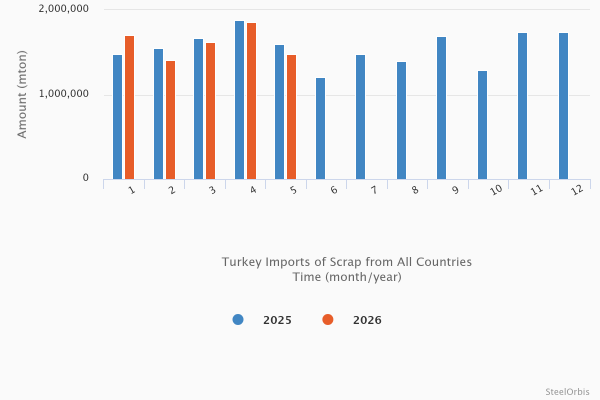
As seen in the table below, Turkey’s scrap imports in the first five months of this year totaled 8.08 million mt, barely 86,197 mt lower than the same period last year. Despite Turkish mills saying that their slower steel demand exerts pressure on scrap prices, their scrap imports do not show much of a year-on-year change. Meanwhile, Turkey’s billet and bloom imports increased by 714,780 mt year on year in this period.
As SteelOrbis previously reported, Turkey’s import scrap market started to move up on September 22, 2025, when prices were at $340.5/mt CFR on average. The uptrend was supported by the lack of scrap availability during the winter season, pushing prices up to $372/mt CFR in January. After a small reduction to $369.5/mt CFR in March, another sharp upward movement was seen in deep sea scrap prices on the back of higher indirect costs due to the US-Iran war, reaching its peak on May 25, at $410.5/mt CFR on average. The current $371.5/mt CFR level is similar almost to the pre-war levels. SteelOrbis believes that, despite some small room being left for further price cuts, Turkey’s import scrap market is ready to enter a sideways trend for the short term unless Turkish mills announce official price cuts in the coming period.
Under the current conditions, the deep sea benchmark HMS I/II 80:20 scrap prices in CFR terms have remained stable week on week. The prices are now 7.47 percent lower month on month in the deep sea segment, with prices being in the range of $368-375/mt CFR.
Negotiations in the US domestic scrap market in July began on Wednesday this week, with some confirmed sales of prime grades, P&S 5ft, and machine shop turnings (MST) at sideways in the Midwest. Some of the prominent mills in the region are trying to push down HMS I by $10/gt as was projected in past weeks; this is due to reportedly robust supply levels and a weak export market on both coasts. Some mills are even trying to purchase shredded down $10/gt from June settled prices but are encountering even more resistance, as some sales for the grade have already been reported at sideways.
Containerized ferrous scrap prices on the US West Coast (USWC) continued to drop on Wednesday as contacts report that Asian mills continue to push prices down and US suppliers keep accepting them. The price of containerized HMS I/II 80:20 fell by $10-15/mt to $310-315/mt FAS Long Beach port, while containerized P&S 5ft dropped by the same margin to $325-335/mt FAS, and containerized shredded to $330-340/mt FAS. Some contacts report seeing HMS I/II 80:20 quoted as low as $305/mt FAS, while others project the price at $295/mt FAS as early as Monday.
Bulk prices to the US East Coast (USEC) continued to fall on Tuesday, with contacts believing that the market had not reached bottom yet. Additionally, traders in the region remain expectant of the outcome of the domestic trading cycle for July, which is expected to begin this week. There is the latent possibility that cut grades, especially HMS I, could decrease by $10/gt in the domestic market. In the meantime, the price of bulk HMS I to New York and Philadelphia docks softened by $5-10/gt to $255-260/gt delivered to export yard, P&S 5ft fell by the same amount to $275-280/gt delivered, and shredder feed prices dropped by $10/gt to $210-215/gt delivered.
Mexican mills continued to lower prices as several are reporting healthy scrap inventories, and some even refused material for several days. Others have issued announcements saying they will not receive scrap in the coming days. Not all mills have dropped their prices despite reporting healthy inventories.
Mills in the northern part of Mexico were unchanged after dropping last week for the first time in this buy-cycle. The price of #1 busheling remained at MXN 7,300/mt ($418/mt) delivered consumer, HMS I was flat at MXN 5,800/mt ($332/mt) delivered, P&S 5ft remained at MXN 6,900/mt ($395/mt) delivered, shredded still sat at MXN 7,700/mt ($440/mt) delivered, and machine shop turnings (MST) were flat at MXN 5,000/mt ($286/mt) delivered.
The Italian scrap market has remained mostly quiet this week, and the scenario is expected to remain unchanged in the coming weeks amid the typical weakness that characterizes the summer season.
The silence in the finished steel segment, characterized by difficult sales and a slowdown in production, has caused scrap prices to gradually weaken and trading activity to decrease in terms of both volumes and the number of deals.
Scrap prices in Italy have decreased slightly compared to last week's levels. It should be noted that, within the HMS scrap grade, E1 stands at €275-290/mt, while E3 stands at €295-320/mt.2
The first rumors in the German scrap market regarding the market trend in July have emerged this week. According to sources, the main steel mills have lowered their scrap purchase prices by €10-25/mt depending on the grade and the producer.
"Mills don't need to buy, and logistics in Germany is incredibly hard. In addition, July is a holiday month, and the shutdowns for maintenance have already begun, so the mills can afford to lower scrap prices. […] A recovery will probably be seen towards the beginning of October, but now it is still too early to say […]," a market player commented.
According to the information gathered by SteelOrbis, a bearish trend for the month of July has begun to emerge in the Polish scrap market this week.
As one source explained, “Market players are already on vacation and will resume work around mid-August, so I expect a very quiet month. Many foundries and steel mills have started summer shutdowns, and scrap demand has decreased compared to the previous month. However, price declines are expected in a range of no more than €10-15/mt.”
Local scrap prices in Poland have been reported at almost unchanged levels compared to last month, i.e., at PLN 1,170/mt for W2 scrap (equivalent to HMS) and PLN 1,190/mt for W7 scrap (equivalent to bonus). As for exports, collection prices of HMS I are stable at around €280/mt DAP.
After a recording a slight cut in June following a ten-month upward rally, Japan’s Kanto scrap export tender recorded another price drop in July. In the July Kanto export tender, the highest bid was at JPY 52,508/mt ($323/mt) FAS, only JPY 1,998/mt lower than last month. The dollar-based price moved down by $17/mt from last month’s $340/mt FAS, taking into account the change in the exchange rate. The FAS prices translate to JPY 53,508/mt FOB or $329/mt FOB, $17/mt lower as compared to last month.
Following the drop observed in the Kanto scrap export tender on July 9, the leading Japanese EAF-based steel producer Tokyo Steel on the same day cut its local scrap procurement prices for all regions and grades. Tokyo Steel’s general purchase price range for H2 grade scrap moved down by JPY 1,000/mt on the lower end as compared to the levels recorded on July 4 to JPY 52,000-54,000/mt ($320-332/mt) depending on the mill. The dollar-based prices increased by $9/mt on the lower end and by $3/mt on the upper end taking the exchange rate changes into account.
Taiwan’s import scrap market has remained on a downward trend amid negative sentiments over the past week, against the backdrop of adverse weather conditions, slower construction activity and the recent sharp decline recorded in the international scrap market.
Offer prices for ex-US HMS I/II (80:20) scrap in containers to Taiwan have moved to $332-337/mt CFR, from the $339-340/mt CFR levels recorded last week. Japanese suppliers returned to the market this week, offering bulk H1/2 (50:50) scrap to Taiwan at $358/mt CFR.
Vietnam’s import scrap market has continued to move down this week, following the general sentiments observed in the international scrap market.
Offers from the US West Coast to Vietnam for bulk HMS I/II 80:20 scrap have softened slightly from $385-390/mt CFR to $380-385/mt CFR. There have been no deals done from the US West Coast to Vietnam this week, sources report. Market sources report that the buyer in the July Kanto scrap export tender was Vietnam, with the total tonnage being 15,000 mt. With the approximate $38/mt freight between Japan and Vietnam, this level indicates a $3/mt drop from last week’s $370/mt CFR Vietnam for H2 grade.
In Pakistan, import scrap prices have remained under pressure over the past week, with some fresh bookings reported at lower levels, while buyers have continued to be cautious and have been asking for additional discounts. In detail, 1,000 mt of ex-EU/UK shredded scrap have been sold at $398/mt CFR Qasim this week, down by $2/mt from the $400/mt CFR Qasim level heard last week. Moreover, the latest offers from the UK and Germany have already been heard closer to $395/mt CFR Qasim, with bids mostly remaining at $390-395/mt CFR. Some sellers are still trying to keep offers at $400/mt CFR and above, and loaded cargoes have been heard offered at higher levels of $405-410/mt CFR Qasim. But even with new rare deals closed at the $400/mt CFR mark, the SteelOrbis reference price has settled at $395-399/mt CFR. Meanwhile, ex-EU/UK HMS 80:20 and GI bundles have been sold at $390/mt CFR Qasim this week. In the Pakistani domestic market, mills’ operating rates have remained well below normal levels, as weak construction activity and subdued finished steel demand have continued to limit production, while uncertainty following the fiscal budget has kept the market unsettled.
In Bangladesh, import scrap prices have remained under pressure over the past week, with prices moving down further amid slow buying, weak finished steel demand and expectations that import scrap prices may still soften. The SteelOrbis reference price for shredded scrap in containers in Bangladesh has decreased by $6/mt on average over the past week to $390-400/mt CFR. More specifically, ex-UK shredded scrap in containers has been sold at close to $400/mt CFR Chattogram, while ex-EU shredded scrap in containers has been assessed at around $396/mt CFR Chattogram, down by around $4/mt compared to last week. As for ex-Australia material, shredded scrap in containers has been sold at $390/mt CFR Chattogram this week. In terms of other origins, ex-Brazil HMS I/II 80:20 scrap in containers has been booked at $355/mt CFR Chattogram this week, lower than offers at $365-368/mt CFR heard at the beginning of the week and compared to $365-370/mt CFR recorded last week. Overall activity for UK/EU material remains limited, with most buyers still expecting prices to soften further in the coming days. In the meantime, the local Bangladeshi market has remained weak, with finished steel demand still slow during the rainy season, while steelmakers are still limiting scrap purchases amid weak sales and uncertainty following the recent budget announcement.