Turkey’s import scrap market has continued its downtrend over the past week, starting with a deal done on Friday, July 10, indicating a sharp fall in the ex-Baltic price index, though SteelOrbis has learned that the cargo was for very prompt shipment. While negative sentiments continue to be observed in Turkey’s import scrap market, more European sellers have started to announce their holidays and that they will be out of the market for at least two weeks, while there is some revival of scrap demand from Turkey.
As market sources returned to the market after Turkey’s Democracy Day holiday on July 15, new rumors of deep sea scrap deals were heard in the market. While negative sentiment persists in Turkey’s import scrap market, collection prices in the supplier regions have also maintained their downtrend. European sub-collectors report that collection prices in the EU are now at €260-270/mt DAP, though they also report that this level is not acceptable to them. Especially, the lower water levels in European rivers are increasing the costs of transportation throughout the region. The situation is no different in the US. Bulk scrap prices to US East Coast docks fell across the board this week, marking the fourth straight week of declines for the New York and Philadelphia docks.
As the main problem of sluggish steel sales persists, Turkish mills are continuing their cautious stance towards scrap purchases as they try to maintain their margins. “It is not even the tonnages, the problem is the profits we earned since the beginning of 2026,” a source at a producer said. With the steel export markets shrinking due to protectionist measures, local demand is also failing to provide support for Turkish mills. SteelOrbis expects deep sea scrap prices to move down slightly before finding a bottom.
As can be seen in the chart below, Turkey’s total import billet and scrap tonnage in the first five months of this year amounted to approximately 10.2 million mt, 628,583 mt higher than the same period last year. The total import tonnage for these two raw materials was 22.9 million mt last year. The difference is the result of significantly higher tonnages of billet imports, despite lower levels of scrap imports (minus 86,197 mt).
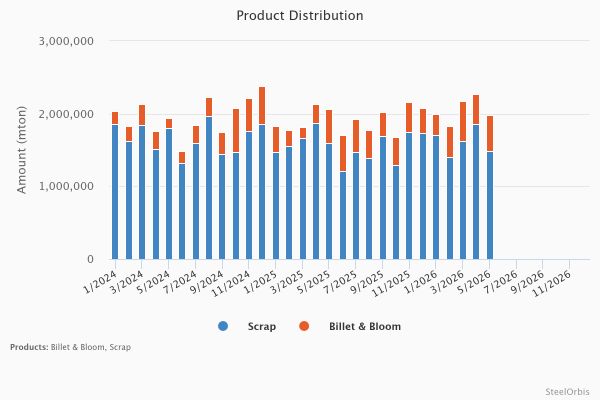
Under the current conditions, the deep sea benchmark HMS I/II 80:20 scrap prices in CFR terms have declined 1.88 percent week on week. The prices are now 6.90 percent lower month on month in the deep sea segment, with prices being in the range of $359-370/mt CFR.
Ferrous scrap prices in the US domestic market remained relatively stable after the July trading cycle. Prime grades trended sideways, as was projected since last month, due to healthy market fundamentals. Some obsolete grades, particularly HMS I and shredded, softened by $10/gt in some markets, particularly in the South and Southeast. These grades were impacted by adequate supply levels and an export market that has been softening for more than a month on both coasts. In July, prices for the local Chicago market remained unchanged for prime grades, with #1 busheling unchanged at $450/gt delivered to consumer and #1 bundles at $455/gt delivered. HMS I fell by $10/gt to $355/gt delivered, while P&S 5ft was unchanged at $400/gt delivered. MST was unchanged at $255/gt delivered. For shredded, some contacts reported selling the grade at a $10/gt price decrease from July settled prices, while others claimed it stayed unchanged; hence, the price fell by $5/gt to $425/gt delivered.
Containerized scrap prices on the US West Coast continued to fall for a seventh consecutive week as HMS I/II 80:20 dropped by $5-10/mt to $305/mt FAS Long Beach port, from $310-315/mt FAS last week. Sources have mentioned that they envision the price falling to $300/mt FAS by the end of the month and that $295/mt FAS could be the market bottom, as suppliers would be expected to draw the line and not issue offers below that level. Some offers at $310/mt FAS for the grade were not accepted.
Bulk scrap prices to US East Coast docks fell across the board this week, marking the fourth straight week for the New York and Philadelphia docks. In Boston, cut grades to the docks remained unchanged this week as shredder feed prices softened due to the last few sellers of the grade that were resisting lower prices finally accepting lower bids, according to contacts in the region. Participants on the US East Coast believe the market bottom could be very close. In the meantime, the price of HMS I to New York docks fell by $5/gt on the lower end to $250-260/gt delivered to export yard, while P&S 5ft fell by $10-15/gt to $260-270/gt delivered and shredder feed fell by $10/gt to $200-205/gt delivered.
Ferrous scrap prices in Mexico for the domestic market continued to fall this week as mills continue to report healthy inventories and some are not receiving scrap for the time being. Some buyers report that they are out of the market altogether as they try to decrease their scrap inventories. Some of the mills' scrap yards are reported by sellers to be “saturated” with scrap. A weak rebar market and softer rebar prices have caused scrap consumption to decline.
This week, some mills were seen implementing MXN 200/mt ($11.45/mt) decreases across the country. Other mills only decreased MXN 200-300/mt ($11.45-17.1/mt) in the Bajio region, while some in the state of Veracruz were seen lowering their prices by MXN 150/mt ($8.6/mt). All in all, mills try to implement lower scrap buying prices to the extent that their scrap inventories allow them to.
In the Italian scrap market, purchase deals have been concluded this week at lower levels compared to the previous ones, with price decreases in line with SteelOrbis’ previous indications.
The few purchases made by Italian mills have been concluded at levels lower by €25-30/mt, though sales are currently coming only from suppliers that need to empty their inventories.
In light of the above, local scrap prices in Italy stand at €275-285/mt for E1 scrap and at €290-315/mt for E3 scrap.
In the German scrap market, some steel producers are lowering their purchase price levels by up to €30/mt month on month.
In particular, producers that rely heavily on scrap deliveries by river are facing several supply issues due to the extremely low water levels on the Rhine, and, in addition to reducing scrap inflows, they have been forced to partly cut production.
However, river logistics are not the only issue. According to a German scrap seller exporting to Italy, both railways and truck transport have also become very complicated.
Meanwhile, the export market has also slowed down. According to one source, collection prices at the ARAG (Amsterdam, Rotterdam, Antwerp and Ghent) ports have decreased to as low as €260/mt DAP for HMS I/II 80:20 scrap, signaling limited buying interest from exporters.
The leading Japanese EAF-based steel producer Tokyo Steel has cut its local scrap procurement prices for all regions and grades, except of Tahara yard. The lack of appetite all over the export markets is exerting pressure on Japanese scrap prices, particularly after the drop seen in the Kanto tender.
The general price range for H2 grade scrap has moved down by JPY 500/mt on the lower end as compared to the levels recorded on July 10 to JPY 51,500-54,000/mt ($317-332/mt) depending on the mill. Including the changes in the exchange rates, the dollar-based quotations have decreased by $3/mt on the lower end and are stable on the upper end.
Despite the slight recovery observed in Taiwan’s rebar market, import scrap prices in Taiwan have continued to move down. The reduced rebar prices leave no profit margins for mills, SteelOrbis understands, and, the less interest they show in scrap given more attractive billet offers, the more scrap prices remain under pressure, with Japanese sellers taking a step back once more.
Offer prices for ex-US HMS I/II (80:20) scrap in containers to Taiwan have moved to $330-332/mt CFR from the $332-337/mt CFR levels recorded last week. Actual prices in ex-US deals have moved down by another $5/mt week on week to $325/mt CFR. After returning to the market last week at $358/mt CFR, offers for Japanese bulk H1/2 (50:50) scrap to Taiwan have disappeared again this week.
While Vietnam’s import scrap prices continue to soften the country remains to be amongst the largest scrap importers in the region. The Vietnam Steel Association (VSA) has stated that Vietnam’s crude steel production reached an estimated 14.8 million mt in the first half of the year, up 21.2 percent year on year, while steel consumption increased 13.1 percent to approximately 17.9 million mt, providing a solid foundation for further growth, according to Vietnamese media reports.
Offers from the US West Coast to Vietnam for bulk HMS I/II 80:20 scrap has softened slightly from the $380-385/mt CFR to $380/mt CFR. There are no deals done from the USWC to Vietnam this week and lack of any new deals is exerting pressure on ex-US price offers.
Bangladesh’s import scrap market has remained subdued over the past week, with prices declining further amid limited buying activity and persistently weak finished steel demand. Although some fresh bookings of competitively priced material from Southeast Asia and Brazil have been reported, mills have continued to purchase selectively and mainly to cover immediate requirements, while the recently announced 17 percent increase in electricity tariffs has added further pressure on production costs and margins. Ex-UK shredded scrap in containers has been offered at around $392/mt CFR Chattogram, down from close to $400/mt CFR last week, while ex-UK HMS I/II 80:20 scrap in containers has been indicated at around $360/mt CFR, compared to $375/mt CFR last week. In concluded business, ex-Philippines and ex-Malaysia GI bundles have been sold at $330/mt CFR and $325/mt CFR respectively, while ex-Brazil HMS I/II 80:20 scrap in containers has been sold at $345/mt CFR. In the bulk segment, ex-US HMS I/II 80:20 scrap has been indicated at around $388/mt CFR, though offers have also been heard at up to $400/mt CFR. The gap between sellers’ offers and buyers’ workable levels has continued to restrict fresh trading activity.
Pakistan’s import scrap market has seen a moderate recovery in buying activity over the past week, driven mainly by renewed concerns over Middle Eastern supply routes and the possibility of further disruptions in the Strait of Hormuz. More specifically, 1,000 mt of ex-UK shredded scrap and 1,500 mt of ex-EU shredded scrap were sold at $390/mt CFR Qasim earlier in the week, down from the $398/mt CFR Qasim deal reported last week. Subsequently, ex-UK/EU shredded scrap has been sold at $393-395/mt CFR Qasim, including a fresh 1,000 mt booking concluded at $395/mt CFR. At least one small booking has been heard at up to $398/mt CFR, while loaded cargoes have been available at around $405/mt CFR Qasim. The market has started to firm up with sellers raising their indications amid renewed concerns over Middle Eastern supply disruptions. Several suppliers are also reported to have temporarily withdrawn from the market, reducing offer availability and adding further support to prices. Current offers for ex-UK/EU shredded scrap have consequently moved up to $395-400/mt CFR Qasim, while buyers have generally continued to target around $390/mt CFR. Meanwhile, a bid for ex-Australia HMS I/II 80:20 has been heard at $355/mt CFR Qasim, although no deal has been confirmed at this level. In the domestic market, local scrap prices have also moved higher despite persistently weak finished steel demand and monsoon-related disruptions. Local commercial-grade scrap prices have increased by around PKR 3,000-4,000/mt ($11-14/mt) over the past week, while local scrap equivalent to shredded has been heard at PKR 146,000-150,000/mt ($525-539/mt) ex-warehouse.