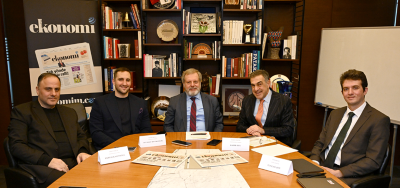
During a visit to Turkish newspaper Ekonomim, the management of the Turkish Foundry Association (TÜDÖKSAD) shared assessments on the current state of the Turkish casting sector and new opportunities emerging in Europe. TÜDÖKSAD stated that rising protectionism in global trade, EU policies, cost pressures and difficulties in accessing finance have brought the Turkish casting sector to a critical threshold, while production losses in Europe have created a new “gap” for Turkey. Emphasizing that the cost of entering the European market has increased, the association underlined that the sector should move forward not with short-term, stopgap solutions, but with a long-term restructuring model.
Many foundries closed, especially in Germany
Noting that the closure of many foundries across Europe, particularly in Germany, could create a significant opportunity for Turkey, Kadir Efe, TÜDÖKSAD chairman, stressed that in order to benefit from this opportunity in a sustainable way, the sector’s financial structure must be strengthened. According to Mr. Efe, there is almost no company in the sector that does not rely on working capital, and, when investment loans are added, the cycle can become unsustainable.
Efe noted that, at a time when global trade is increasingly shifting toward a political and geopolitical framework, the sector’s biggest test will be in the areas of efficiency, capital structure and strategic planning. He emphasized that cost pressure cannot be explained solely by labor, inflation and energy, pointing out that inefficiency is one of the core problems.
Call for focus and flexibility instead of a “capacity race”
The TÜDÖKSAD chairman stated that a growth strategy focused on capacity expansion should be abandoned in order to survive global competition. Drawing attention to examples from Spain and Italy, Efe said that, beyond scale, the right customer-right market match and a flexible production structure have become decisive, while adding that capacity increases often translate into higher borrowing and financial burdens.
Meanwhile, Ekrem Kanıtoğlu, TÜDÖKSAD board member, said that, at a time when global competition is intensifying and price pressure from China is increasing, the Turkish casting sector must undergo a fundamental transformation in its production structure in order to survive. Noting that Turkey is currently fully exposed to global markets, Mr. Kanıtoğlu emphasized that measures are needed against the pressure driven by China.