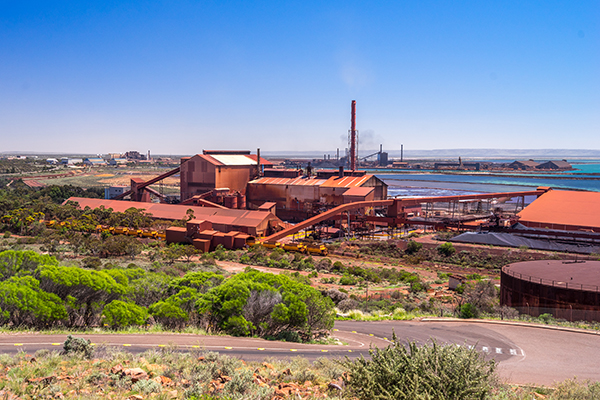
Australia’s Whyalla Steelworks redevelopment is facing increasing scrutiny after the South Australian government backed a long-term gas supply strategy.
Analysts warn that the approach could undermine both the project’s competitiveness and its decarbonization pathway.
IEEFA highlights structural risks
According to a briefing by the Institute for Energy Economics and Financial Analysis (IEEFA), relying on gas as a primary energy source risks placing the project at a disadvantage as the global steel industry accelerates its transition toward green hydrogen.
The criticism follows a 10-year agreement with Santos to supply around 20 petajoules of gas annually from 2030, effectively doubling the state’s industrial gas demand.
Rising energy costs add pressure
The report notes that recent geopolitical developments, including the Iran conflict, have driven up global oil and gas prices, increasing cost uncertainty.
Compared to regions such as the Middle East and North Africa, where gas prices remain significantly lower, Australia’s higher cost base could weaken its competitiveness.
Emissions gap between gas and hydrogen
IEEFA emphasized that while gas-based DRI is often seen as a transitional solution, it still generates relatively high emissions, estimated at around 1.7 mt carbon per mt of steel.
In contrast, hydrogen-based steel production powered by renewable energy can reduce emissions to below 0.1 mt carbon per mt of steel.
Global shift toward hydrogen accelerates
Leading steel-producing regions are increasingly adopting hydrogen-based technologies to reduce emissions and enhance energy security.
Countries such as China are expanding hydrogen-focused steelmaking strategies, while regions like Oman are leveraging low-cost gas with clear pathways toward hydrogen conversion.
Call for phased transition
The report recommends a phased transition strategy, where gas-based DRI would gradually be replaced by green hydrogen throughout the 2030s. This approach would align the Whyalla project with global decarbonization trends.
While public support for the Whyalla project is considered justified due to its strategic importance, IEEFA stresses that funding should prioritize reducing green hydrogen costs and supporting demand for low-carbon steel. Without such adjustments, the project risks locking in fossil fuel dependency and falling behind in the global steel transition.