Direct iron electrolysis could establish a niche role in smaller-scale green iron production, particularly in regions with abundant renewable electricity and lower-grade iron ore resources, according to a new briefing note from the Institute for Energy Economics and Financial Analysis (IEEFA).
The technology could offer advantages over other low-carbon ironmaking routes by using lower-grade ores with limited or no additional processing and requiring less supporting infrastructure. However, IEEFA said scalability and access to affordable clean electricity remain key challenges.
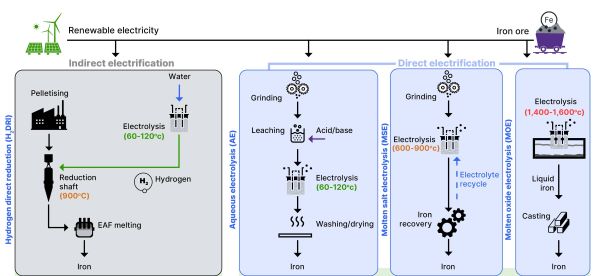
Direct electrolysis could use ores as low as 35 percent Fe
IEEFA identified three main pathways: low-temperature electrowinning, molten salt electrolysis and molten oxide electrolysis. When powered by clean electricity, these processes have the potential to produce near-zero-emission iron.
Some electrochemical processes could use magnetite containing as little as 35% Fe, while eliminating the need for coal, natural gas or hydrogen as reducing agents. They could also remove conventional stages such as cokemaking, sintering and pelletizing.
According to IEEFA, these characteristics could make direct electrolysis suitable for smaller green iron projects in renewable energy-rich regions.
Commercial scalability remains a challenge
Despite its potential, IEEFA said commercial-scale production has yet to be demonstrated, with current output limited to tonnes per day at best. Electricity also remains the main cost driver, making access to abundant and inexpensive clean power critical.
Companies developing electrochemical ironmaking technologies include Boston Metal, Electra and Volteron, while Fortescue and Element Zero are developing their own approaches.
IEEFA concluded that although direct iron electrolysis remains at an early stage, its ability to use lower-grade ores and potentially operate flexibly with renewable power could give it a role in future green iron production.