Swedish iron ore producer LKAB has announced that it has started laying the foundations for its new sorting plant at the Malmberget mine in Gällivare, Sweden. The new facility is intended to secure stable production, increase processing capacity and enable the handling of apatite-rich material for the company's planned production of phosphorus and rare earth elements.
The new sorting plant will replace the existing facility, which has been operating since 1953 and is constrained by its age and limited space. According to LKAB, the new plant will provide a more robust production process with fewer disruptions and higher iron recovery, while also improving working conditions and operational safety. During the sorting process, crude ore is crushed, screened and magnetically separated before being sent for beneficiation and subsequently processed into fines and pellet products.
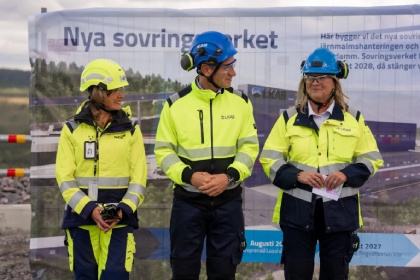
New plant to increase annual capacity by up to 8 million mt
The new facility will have an annual capacity of 25 million mt of crude ore, representing an increase of approximately 7-8 million mt per year compared with the existing capacity.
The plant is also being prepared to process apatite-rich tailings for the future recovery of apatite. The recovered material is intended to be used in LKAB's planned production of phosphorus and rare earth elements in Luleå.
SEK 6 billion facility scheduled to start operations in 2028
LKAB's board approved an investment of SEK 6 billion (€541.59 million) in the new sorting plant in September 2025. The facility is scheduled to become operational in 2028 and, with a volume of 620,000 cubic meters, will be one of the largest facilities constructed in the company's history.
Sweden-based construction company NCC is serving as the main contractor for the project. According to LKAB, the facility is being constructed in sections so that individual sections can subsequently be taken offline for maintenance without disrupting the entire process.
The new plant will feature integrated dust extraction systems and sound absorbers. LKAB expects noise, dust and carbon dioxide emissions to decrease as existing outdoor sorting operations are phased out and truck transportation is reduced. The facility will also enable steel fibers from rock reinforcement to be separated, reducing wear on downstream equipment.