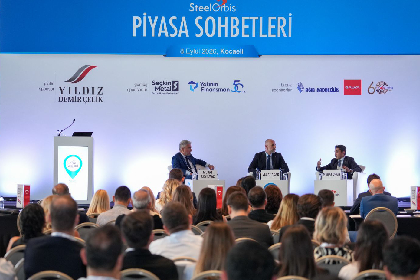
The SteelOrbis' Market Talks meeting, held at Elite World Grand Sapanca on September 8, 2026, brought together more than 650 industry participants, with Yıldız Demir Çelik as the main sponsor, and Seçkin Metal, Yatırım Finansman, Ağır Haddecilik, Galva Metal and Yametaş as the other sponsors. The meeting addressed the shifting dynamics in global steel trade, the EU's new safeguard measures, energy and logistics costs, flat steel demand in Turkey, financial pressures and expectations for the second half of 2026.
Overcapacity is the main problem facing the global steel industry
Selçuk Yılmaz, general manager of Yıldız Demir Çelik, stated that the main problem facing the global steel industry is not fluctuations in demand but the rapid increase in production capacity, noting that global excess capacity is expected to reach 750 million mt by 2030. Yılmaz said that India stands out in terms of new capacity investments, while China is increasing price and competitive pressures in international markets by directing its surplus production to exports, drawing attention to the fact that China's steel exports reached 75 million mt in the first eight months of 2026. He stated that rising capacity and export volumes are prompting countries to adopt stronger protectionist measures, adding that the EU's approximately 47 percent overall reduction in steel import quotas and its decision to raise the above-quota duty from 25 percent to 50 percent have significantly narrowed Turkish exporters' room for maneuver. Based on the currently available data, the reduction in quotas allocated to Turkey is estimated at approximately 36 percent. The Yıldız Demir Çelik general manager also noted that the tightening of quotas in the UK market has limited Turkish producers' export opportunities, stressing that Turkey must protect its domestic market against low-priced imports that do not comply with standards while simultaneously dealing with trade barriers in overseas markets. Yılmaz said that trade policies are no longer limited to quotas and antidumping duties, noting that the “melt and pour” rule and carbon costs are reshaping the entire value chain, from purchasing decisions to supplier selection. He added that the fact that the same hot rolled coil is traded at approximately $500/mt in China, $600/mt in Turkey, $850/mt in the EU and $1,300/mt in the US clearly illustrates the fragmentation of the global price structure caused by protectionist measures. According to Yılmaz, the fact that exports to the US remain possible despite the 50 percent Section 232 tariff demonstrates that high trade barriers also create high-priced markets.
Around one-third of Turkey's flat steel capacity remains idle
Vedat Acar, sales director at Yıldız Demir Çelik, stated that, although Turkey's flat steel production and consumption increased year on year in the first seven months of 2026, conditions in the market were not equally positive. Acar said that the capacity utilization rate in Turkey's flat steel sector has mostly remained within the 60-65 percent range in recent years and stood at approximately 66 percent in the first seven months of 2026, meaning roughly that one out of every three machines in the sector was idle. He noted that weak domestic demand, import pressure and protectionist measures in export markets have intensified price competition, adding that the sector should focus on value-added coated products, import substitution, high-strength lightweight steels and products for the solar energy industry in order to achieve growth.
Delivery reliability is as important as price in domestic sourcing
Murat Urun, general manager of Ram and vice chairman of TURKTRADE, stated that Turkish steel producers have considerable competitive strength in terms of prices and product quality, but need to improve delivery reliability and predictability. Pointing out that a low-priced product loses its advantage if it is not delivered on time, Urun said that delays lead to higher inventory, working capital and financing costs for customers. He stated that domestic producers should offer lower minimum order quantities, on-time delivery, regular production updates and stronger customer communication, stressing that competition should be based not only on product prices but also on a service-oriented approach covering the entire value chain, from order placement to after-sales support.
Protectionism redirects trade rather than stopping it
Hakan Bozoğlu, export manager at Yıldız Demir Çelik, stated that protectionist measures do not bring global steel trade to an end, but merely redirect trade flows, adding that producers need to position themselves correctly amid this shift. Bozoğlu said that Europe's share in Turkey's total exports of steel products subject to quotas has generally stood at around 30 percent over the past six years. Given weak demand and low capacity utilization rates, he noted that withdrawing from export markets is not an option and that producers should instead expand their customer and market portfolios. The Yıldız Demir Çelik export manager stated that trade measures imposed by various countries against China and South Korea would redirect tonnages from these countries toward alternative markets, intensifying competition for Turkish producers in export destinations. He added that Turkey should make more effective use of its logistical advantage in nearby markets. Bozoğlu identified ensuring value chain traceability, incorporating information on the country where the steel was melted and poured into purchasing decisions, and optimizing logistics processes as key priorities for trade compliance. He said that the most significant risk over the next 12 months would be deteriorating navigational safety in the Black Sea and prolonged port delays, while the most tangible opportunity would be the reconstruction process in Syria, which could gain momentum as sanctions are gradually eased.
Country of melt and pour becomes decisive for exports
Bülent Hacıoğlu, managing partner at Trade Resources Company, stated that exporters are required under the EU's new import regime to declare the country where a steel product was first transformed into a solid state. Noting that this information could subsequently be used in quota, antidumping and countervailing duty practices, Hacıoğlu stressed that the origin of inputs and the entire production chain must be fully traced for cold rolled or galvanized steel produced in Turkey using imported hot rolled coil. Hacıoğlu stated that practices aimed at preventing the circumvention of trade measures are becoming increasingly widespread in both the US and the EU, adding that the country where the product undergoes final processing may no longer be considered sufficient on its own and that the origin of the raw material used could become decisive.
Carbon management is now part of financing and procurement processes
Figen Tabak Balbal, HSE and sustainability manager at Yıldız Demir Çelik, stated that verified actual emissions data could provide producers with a significant cost advantage compared to the EU's default values. Balbal said that Yıldız Demir Çelik had conducted a preliminary verification study for its direct and indirect emissions data for 2025, adding that the company had begun considering verifiable emissions data alongside quality and price in its supplier selection process. Describing the establishment of the legal framework for Turkey's emissions trading system as a positive step, Balbal stated that Turkey should also rapidly introduce its own carbon border adjustment mechanism to protect domestic producers. She summarized the sector's priority by stating, “Those who cannot manage their data cannot manage their market.”
Timing is critical in emissions verification
Ladin Çamcı, chief technology and sustainability officer and board member at CARES, stated that the overlap between the EU's new safeguard measures and the Carbon Border Adjustment Mechanism would create a serious cost burden for exporters. Çamcı said Turkish producers should not regard carbon accounting merely as a compliance or reporting matter, highlighting the importance of integrating verified data into commercial strategies, contracts and market selection processes. She stated that Turkey's high share of electric arc furnace-based production could provide a significant competitive advantage if documented correctly. Çamcı stressed that companies should complete their data infrastructure and verification processes in the short term and develop a comprehensive long-term strategy encompassing energy efficiency, clean energy use and decarbonization investments.
Following the panel sessions, the meeting concluded with presentations by Dr. Barış Esen, corporate communications director at Yatırım Finansman, who discussed the impact of recent geopolitical developments on Turkey's industrial sector, and Prof. Dr. Hakan Kara, professor of central banking and financial markets at Bilkent University's Department of Economics, who assessed the current state and outlook of the Turkish economy.