Australian iron ore miner Fortescue Metals Group has announced that it has begun construction of the Nullagine wind project in Western Australia’s Pilbara region, marking a key milestone in its plan to achieve its net zero emissions target.
With an installed capacity of 133 MW, the project represents Fortescue’s first operational wind development and forms the foundation of a broader wind portfolio planned for rollout during this decade.
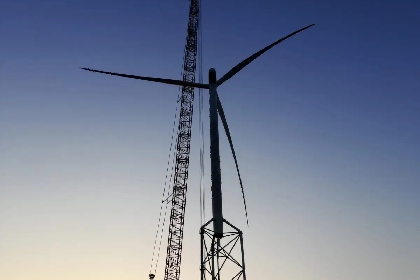
Part of wider Pilbara renewable program
The Nullagine wind project follows progress at Fortescue’s Cloudbreak solar farm, where more than 300,000 photovoltaic panels have already been installed as part of the group’s Pilbara renewable energy program.
The project will comprise 17 wind turbines supplied by China-based energy company Envision Energy. The turbines are designed for low-wind conditions and engineered to withstand extreme weather events, including cyclones common to the Pilbara.
They will incorporate self-erecting tower technology from Nabrawind, which Fortescue recently acquired. Using Nabrawind’s Nabralift system, the turbines will reach a hub height of 188 meters, setting a new global benchmark for onshore wind and significantly increasing energy yield.
A prototype turbine using this integrated design has already been installed at an Envision testing facility in China and is scheduled to be relocated to the Pilbara in June 2026.
Replacing diesel and gas across mining operations
Fortescue CEO Dino Otranto said the Nullagine project is central to replacing diesel and gas with large-scale renewable energy across Fortescue’s Pilbara operations, including haul trucks, drilling activities, processing plants and rail infrastructure.
He noted that wind generation, combined with solar and battery storage, will provide reliable and low-cost power, helping to balance daytime solar output with stronger night-time and seasonal wind generation through the Pilbara Energy Connect network.
Looking ahead, Fortescue plans to deploy 2-3 GW of renewable generation and battery storage capacity across the Pilbara by 2030, through a portfolio of wind and solar projects. These developments remain subject to land access arrangements and regulatory approvals.