During the panel discussion "Rolling in the deep! Are we risking EU industrial desertification?", held during the EUROMETAL Southern Europe Meeting 2026 on February 26 in Milan, Franco Felisa (ESN, Electromechanics Synergy Network), Tommaso Sandrini (Assofermet, San Polo Lamiere), Tayfun Iseri (YİSAD/Çolakoğlu Metalurji), and Piotr Sikorski (PUDS) debated the growing risk of industrial desertification in Europe.
Franco Felisa opened the debate with a lucid analysis of current market pressures, highlighting how European companies must face raw material and energy costs that are 40-50 percent higher than those of global competitors. He even evoked an extreme proposal that had already circulated in mid-February, namely, a coordinated shutdown of plants for an entire day as an act of protest. "Talking to Brussels is painful," he noted, adding, "They listen, but then they ask you for numbers, as if they don't live in the same reality."
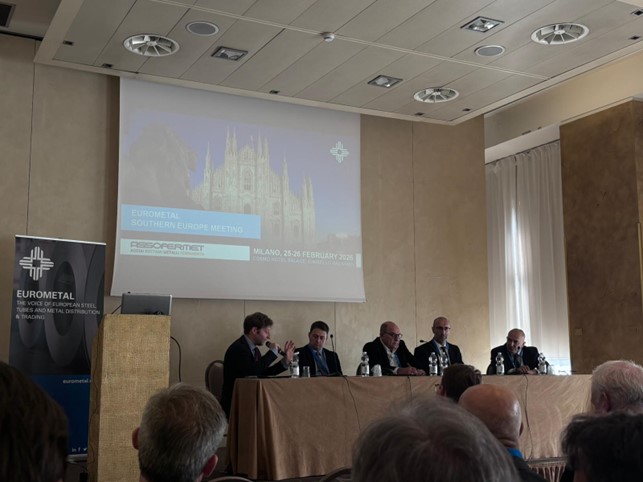
The same risk of industrial desertification is present in the Polish market, as highlighted by Piotr Sikorski, who said it does not only concern large producers. Sikorski explained how the crisis is hitting distribution: "There’s no single week when I don’t have a call from a distributor who is closing their lines or reducing their activity. Deindustrialization is not an idea hanging somewhere over there, but an ongoing process. To stop it, we must actively focus on the areas not represented by the government: distributors, users and small businesses."
From Poland, the focus shifted to Turkey, one of Europe's closest partners. Turkish production capacity is around 40 million mt, of which 20-25 million mt are exported to Europe. According to Tayfun Iseri, the market is facing several difficulties, but the biggest problem is the constant concern over costs. He stated, "We're too focused on the cost problem, when the real problem is that we don't know how to grow demand." Regarding the risk of relocation, Iseri emphasized that most Turkish industries are family-owned and very proud of this: they would do everything possible to avoid bankruptcy, but it is unknown how long they can survive.
The environmental paradox
The hottest topic remains climate regulations. Although the goal of decarbonization is shared, the methodology is a subject of criticism. Felisa defined CBAM and safeguards as "accelerators of desertification". "Both systems work for and against us," Sikorski added.
In his intervention, Tommaso Sandrini observed that time is running out and that in two years, when downstream products become part of the scope of CBAM, we will have lost downstream sectors that will not return. "There is an increasing level of awareness within the economic community, but we do not see the same level of awareness within political institutions, even less in Brussels," he commented.
In addition to the complexity and implementation of CBAM, Sandrini also criticized its environmental effectiveness. "European steel accounts for only 0.3 percent of global emissions. We are killing our value chains for a result that is irrelevant on a global level," he said. The perception among participants at the EUROMETAL event was that CBAM was born as an environmental protection measure, only to become a true trade defense tool. "Nobody is saying anything about the environment right now. This is crazy," commented Sikorski. Iseri added, "We started from the environment, but I think now it's turning into a kind of protectionism."
In essence, the speakers agreed that the time for diplomacy is up, stressing that Europe must protect not only those who produce steel, but especially those who use it. Otherwise, they concluded, the continent's future will be that of a large buyer of finished products, with a manufacturing industry reduced to a distant memory.